In Temple Terrace, FL, a screen enclosure without a weatherproof roof may sit in the rear yard, no closer than 5 feet to any property line, and it is permitted by the city, not Hillsborough County. Temple Terrace has been an incorporated city since May 28, 1925, with its own Building and Permitting office at 11250 N. 56th St. Its 26,690 residents (2020 census) live in ZIPs 33617 and 33637.
The city was planned in the 1920s as a Mediterranean Revival golf course community, one of the first of its kind in the United States, and the Hillsborough River runs through its eastern and southern parts. Old lots, old trees and a river: all three show up in how enclosures here wear and what the city expects of them.
Temple Terrace city code for screen enclosures
The city's accessory structure rules set where a cage goes and how it must be kept. What they say, and what that means in your yard:
| Rule | City wording or requirement | What it means |
|---|---|---|
| Location | Screened enclosures without a roof impervious to weather may be located in a rear yard | No front-yard or side-yard cages |
| Setback | No closer than five (5) feet to any property line | Measure from the lot line, not the fence |
| Lot coverage | Capped at 47.5% | House, slab and structures together count |
| Upkeep | All accessory structures maintained to avoid deterioration | Torn screen and rusted frames are a code matter |
| Permit | City Aluminum Structure permit application | Not a Hillsborough County permit |
| Permit form asks for | Height at side, new or existing slab, setbacks, qualifier name and state license number | Have measurements and the contractor's license ready |
| HB 803 exemption | Non-structural work under $7,500 approved by the building official before work starts | Ask first, never after |
| Owner-supervised repairs | Ordinary minor repairs on an owner's primary residence | Rental homes are treated as commercial and need permits |
Swipe the table sideways to see every column →
From the City of Temple Terrace Accessory Structures page, Aluminum Structure permit application, Permitting Services page and HB 803 exemption notice (templeterrace.gov), fetched 2026-10-13. The city's permit fee is not verified here; ask when you apply.
The roof wording matters
The rear-yard allowance is written for enclosures "not having a roof impervious to weather," meaning a screen roof. For a solid aluminum pan or insulated roof section, ask the city how it will be treated before you design one.
The upkeep rule is enforceable
Because accessory structures must be maintained to avoid deterioration, a cage with torn panels and peeling paint is more than an eyesore here. A pool cage rescreening and a frame repaint are the usual cure. For permits countywide and in the other Tampa Bay cities, see the pool enclosure permit guide.
Oaks, leaves and Temple Terrace screens
Temple Terrace's sand live oaks are its signature, and they are the main reason cage roofs wear out here. The city is a Tree City USA, and its golf course community, the Temple Terrace Golf and Country Club, and parks like Woodmont Park all sit among big oaks. Leaves and twigs collect on screen roofs, hold moisture and weigh panels down, and falling limbs tear them.
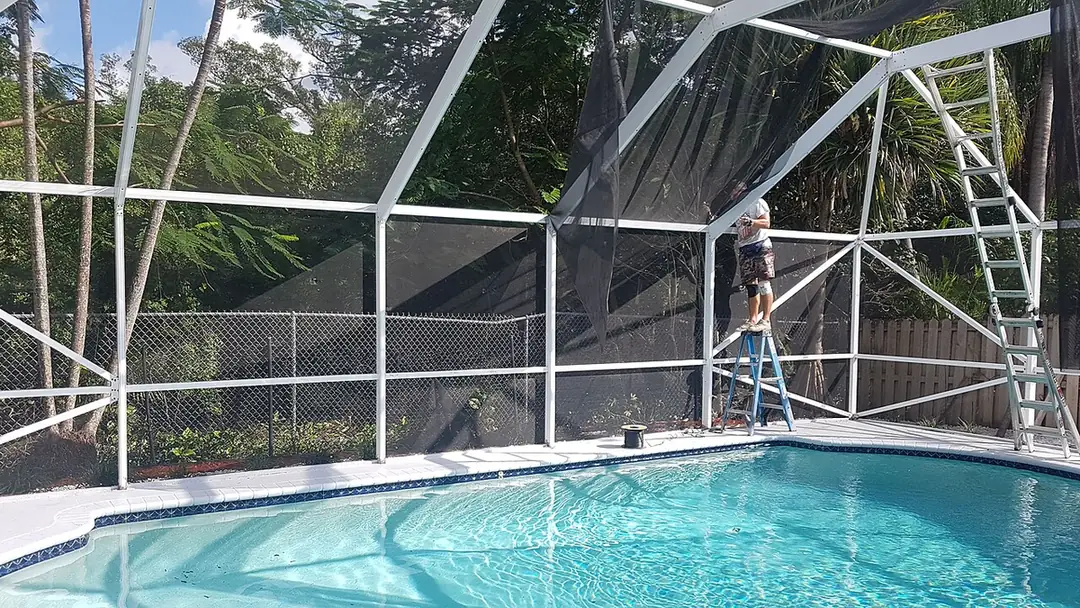
- Roof panels sagging or bellied with leaf litter
- Holes and tears where twigs and limbs came down
- Dark staining on shaded screen that won't rinse off
- Gutters clogged with leaves, overflowing onto the deck
- A screen door that sticks because the frame has shifted
Small tears are pool screen repair, priced per panel; a clogged or leaking super gutter is pool cage gutter repair. The pool cage cleaning guide covers keeping a roof clear between rescreens.
Milton, the river and hurricane prep
Temple Terrace logged 15.66 inches of rain from Hurricane Milton, more than Plant City (13.05) or Riverview (11.91) in Bay News 9's tally. The Southwest Florida Water Management District diverted high Hillsborough River flows to McKay Bay, which it said protected Temple Terrace and Tampa from river flooding. Milton's gusts across Hillsborough County ran mostly 80 to 100 mph, per the National Weather Service.
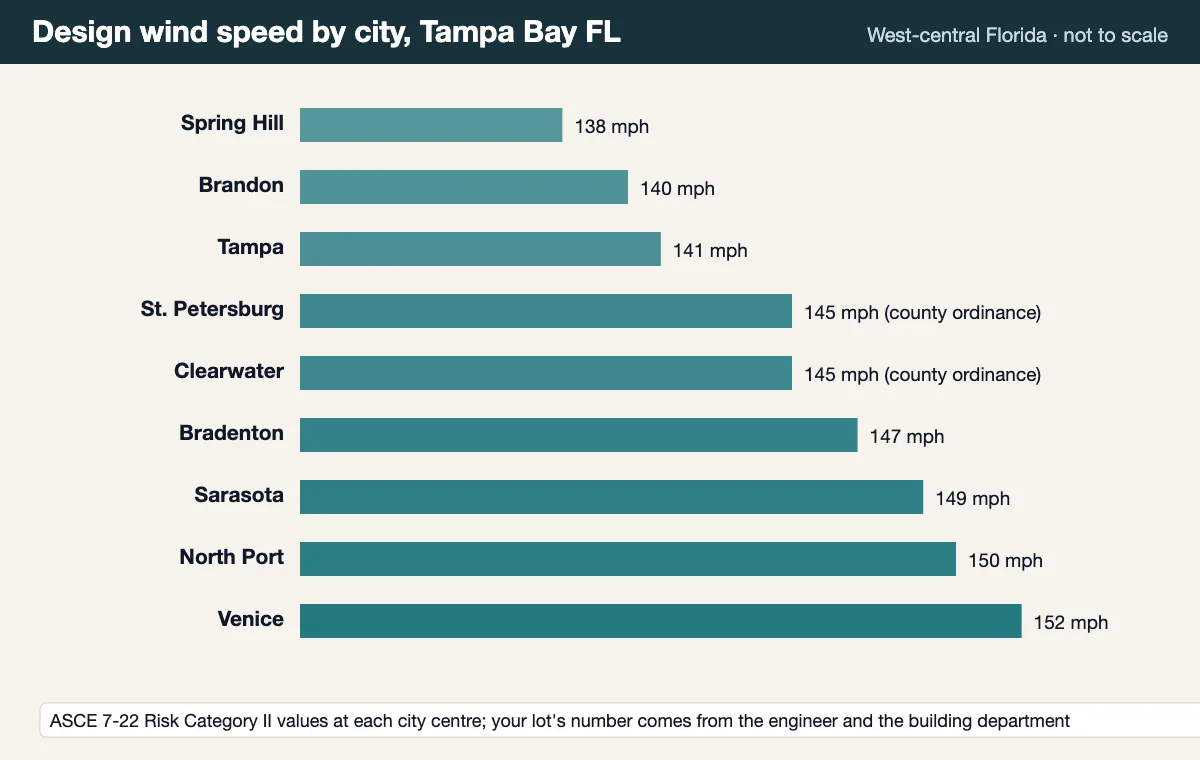
A cage can't be made hurricane proof; it is engineered to a design wind speed, about 141 mph for nearby Tampa under ASCE 7-22. What you can control is what is inside it and what is hanging over it. Before a storm:
- 1Clear the cage
Bring furniture, grills, planters and toys inside or into the garage. Loose items become debris that tears screen from the inside.
- 2Take out removable panels
Removable vinyl, glass or acrylic panels carry a decal saying they shall be removed when wind speeds exceed 75 mph, per Florida Building Code Section 2002.3.3.
- 3Cut screen only if the cage was designed for it
Florida's alternative screen-removal design lets an engineer mark panels to cut when winds above 75 mph are forecast. On a cage not designed that way, leave the screen alone.
- 4Look up at the trees
Note limbs hanging over the cage roof so they can be trimmed before the next season, not during a warning.
- 5Leave on time
A structural engineering firm that studied screen removal says nobody should risk their life cutting screens instead of evacuating or sheltering.
Temporary and seasonal screening
The cleanest way to screen a porch only when you want it is a retractable screen. It rolls down over the opening and back into a housing when you don't. Published prices: manual systems from $899 to $1,499 and motorized from $2,299 per garage-door opening in Tampa Bay, and $3,000 to $6,000 installed for a top-quality motorized screen in Central Florida.
Removable vinyl or acrylic panels are another seasonal option for cool months, with the 75 mph removal rule above. A permanent screened room on an existing slab is a patio screen enclosure; see retractable screens for roll-down options.
What screen enclosure work costs in Temple Terrace
Most jobs here are repairs and rescreens on older cages: roughly $75 to $150 a panel or $1,500 to $4,500 for a whole cage.
| Job | Range | Source and date |
|---|---|---|
| Single panel | $75 to $150 | Tampa Bay contractor guide, Jan 2026 |
| Full rescreen | $1,500 to $4,500+ | Florida contractor price guide, Dec 2025 |
| Pressure wash | $150 to $300 | Tampa Bay contractor guide, Mar 2026 |
| Super gutter, new or replaced | $15 to $30 per linear ft | Central Florida gutter company, Mar 2026 |
| Frame repaint | $1.50 to $2.50 per sq ft | Tampa Bay contractor guide, Jan 2026 |
| Retractable screen, motorized | From $2,299 per opening | Tampa Bay price list, 2026 |
| New pool cage | $10,000 to $30,000+ | Tampa Bay contractor price list, 2026 |
Swipe the table sideways to see every column →
Compiled from published contractor price pages, fetched 2026-10-13. Planning ranges, not quotes.
For a new build, see pool enclosure installation. Nearby Brandon and Lutz have their own pages, and every town is on the service area page. Request a free quote when you're ready.