Last reviewed October 2026. Code text from the 2023 Florida Building Code; storm data from National Hurricane Center and National Weather Service Tampa Bay reports.
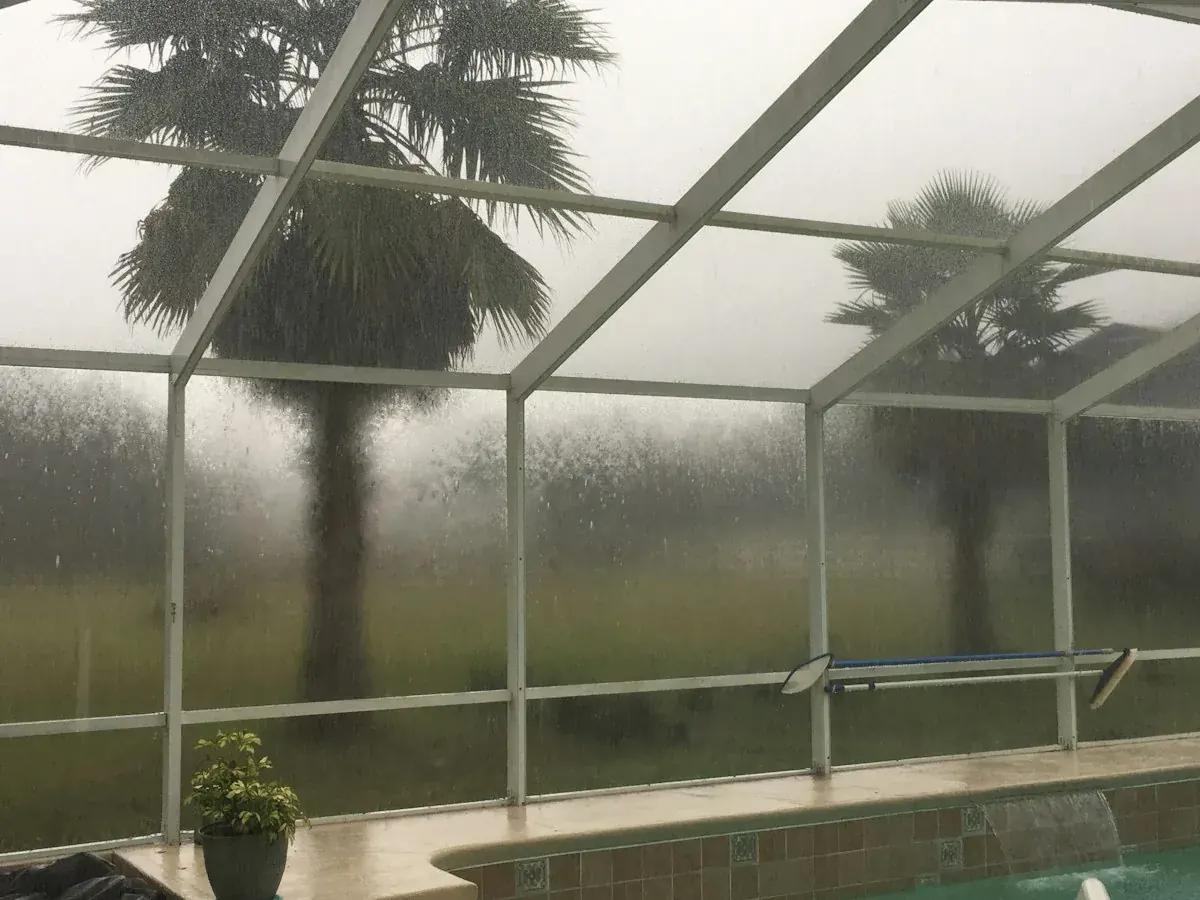
No, pool cages are not hurricane proof. They are engineered to a design wind speed, which for an ordinary home in Tampa Bay, FL is roughly 138 to 152 mph depending on where you live. No code calls a cage storm proof. The strongest gusts measured in the region during Hurricane Milton stayed below those design speeds, yet cages still came apart, and a corroded, loose or debris-struck cage can fail well below its rating.
The rest of this guide explains how the code designs a cage, what speed applies in your town, what the last four hurricanes did across Hillsborough, Pinellas, Pasco, Manatee, Sarasota and Hernando counties, and what the often-misquoted cut-screen rule actually says.
How Florida code designs a pool cage for wind
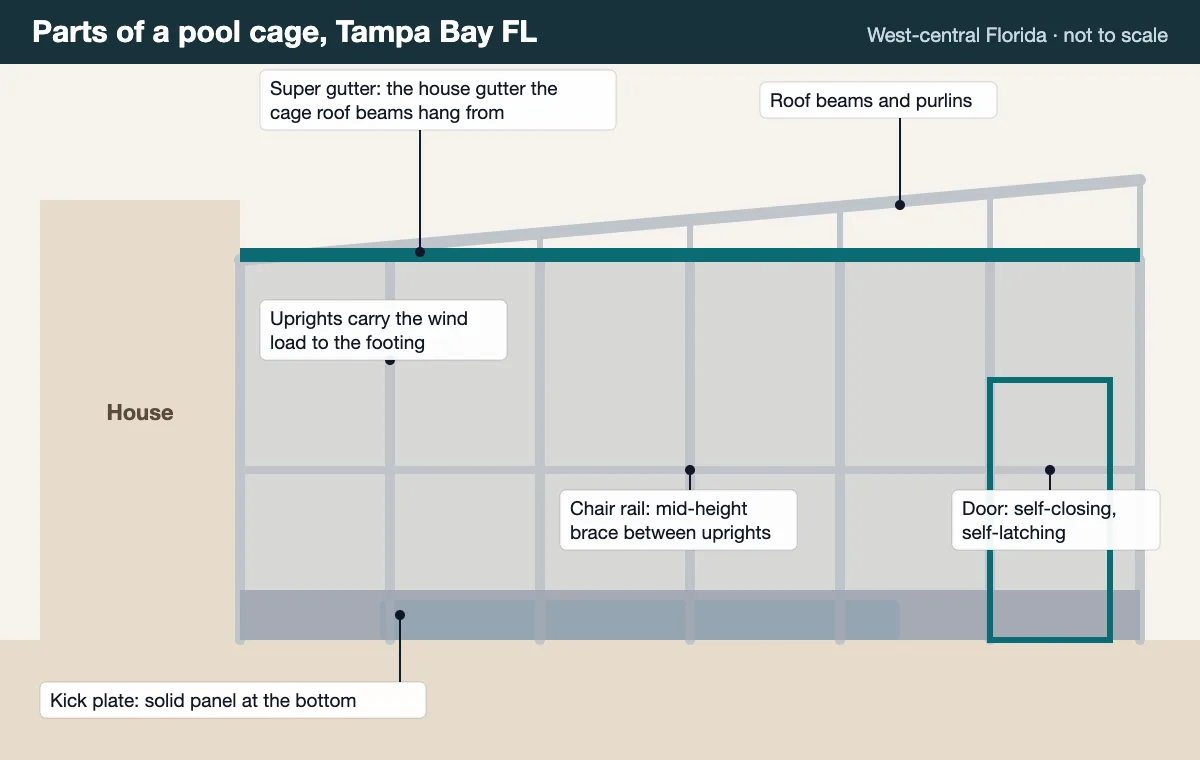
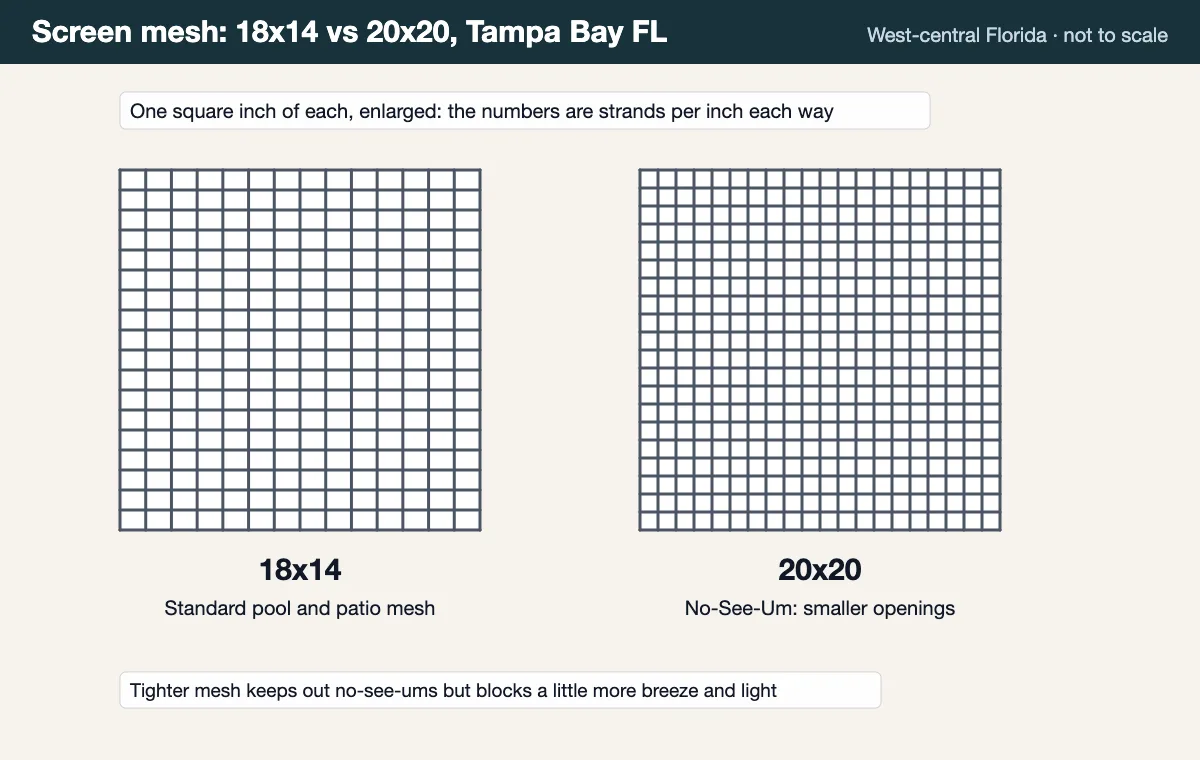
Section 2002 of the Florida Building Code requires the frame to be designed for wind from two directions using a table of pressures by design wind speed. That table, 2002.4, covers ultimate wind speeds from 110 to 170 mph in exposure categories B, C and D, and its pressures assume the cage is covered in 20 x 20 x 0.013 mesh screen. In other words, the standard design counts the screen as part of the load.
- Extruded aluminum members must be at least 0.040 inch (1 mm) thick (2002.3.1).
- Each primary member, such as a beam, post or structural gutter, must also carry 300 pounds applied downward along any 1 foot (2002.4).
- The Aluminum Association of Florida's Guide to Aluminum Construction in High Wind Areas is accepted as conforming engineering (2002.4.1).
- Removable vinyl, glass or acrylic panels must carry a decal: remove when wind speeds exceed 75 mph (2002.3.3).
- The building official may require any aluminum structure to be designed by a Florida-registered professional engineer.
Hillsborough County's permit checklist also requires the structure's Risk Category on the plans. For an ordinary home that is Risk Category II, and the wind speed for Risk Category II represents a 700-year mean recurrence interval event.
Design wind speeds across Tampa Bay
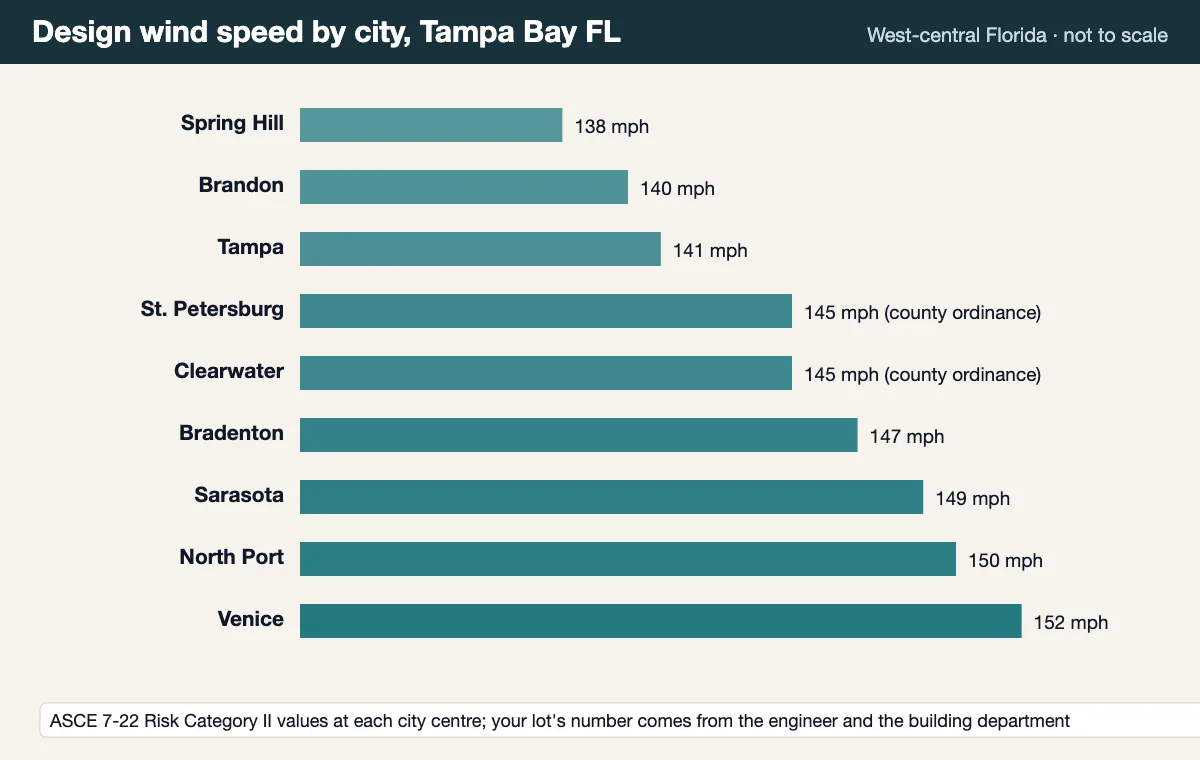
Design wind speeds rise from about 138 mph inland in Pasco and Hernando to about 152 mph at Venice. Pinellas County is the only county here that fixes the number by ordinance: 145 mph for Risk Category II, countywide. The other values below come from the ASCE 7-22 wind data the 2023 code allows, queried at each city's center point.
| City (county) | Design wind speed | Basis |
|---|---|---|
| Tampa (Hillsborough) | About 141 mph | ASCE 7-22 map value at city center |
| Brandon (Hillsborough) | About 140 mph | ASCE 7-22 map value at city center |
| St. Petersburg (Pinellas) | 145 mph | Pinellas County ordinance (map value 145.8) |
| Clearwater (Pinellas) | 145 mph | Pinellas County ordinance (map value 146.1) |
| Wesley Chapel (Pasco) | About 138 to 140 mph | ASCE 7-22 map value at city center |
| Spring Hill (Hernando) | About 138 to 140 mph | ASCE 7-22 map value at city center |
| Bradenton (Manatee) | About 147 mph | ASCE 7-22 map value at city center |
| Sarasota (Sarasota) | About 149 to 150 mph | ASCE 7-22 map value at city center |
| North Port (Sarasota) | About 150 mph | ASCE 7-22 map value at city center |
| Venice (Sarasota) | About 152 mph | ASCE 7-22 map value at city center |
Swipe the table sideways to see every column →
Pinellas value from the PCCLB local technical amendment to FBC 2023 Sec. 1609.3. Other values queried from ASCE's ASCE 7-22 geodatabase (700-year MRI, 3-second gust) on 2026-10-13 at city-center points only. Your site's speed can differ, and only Pinellas's adopted value was confirmed on an official page. Confirm with your building department.
One local threshold to know: Hillsborough County notes that a design wind speed of 140 mph or more is part of the test for whether a home sits in a windborne debris region, where windows and doors need added protection. Much of the region sits near that line.
What Hurricane Milton showed
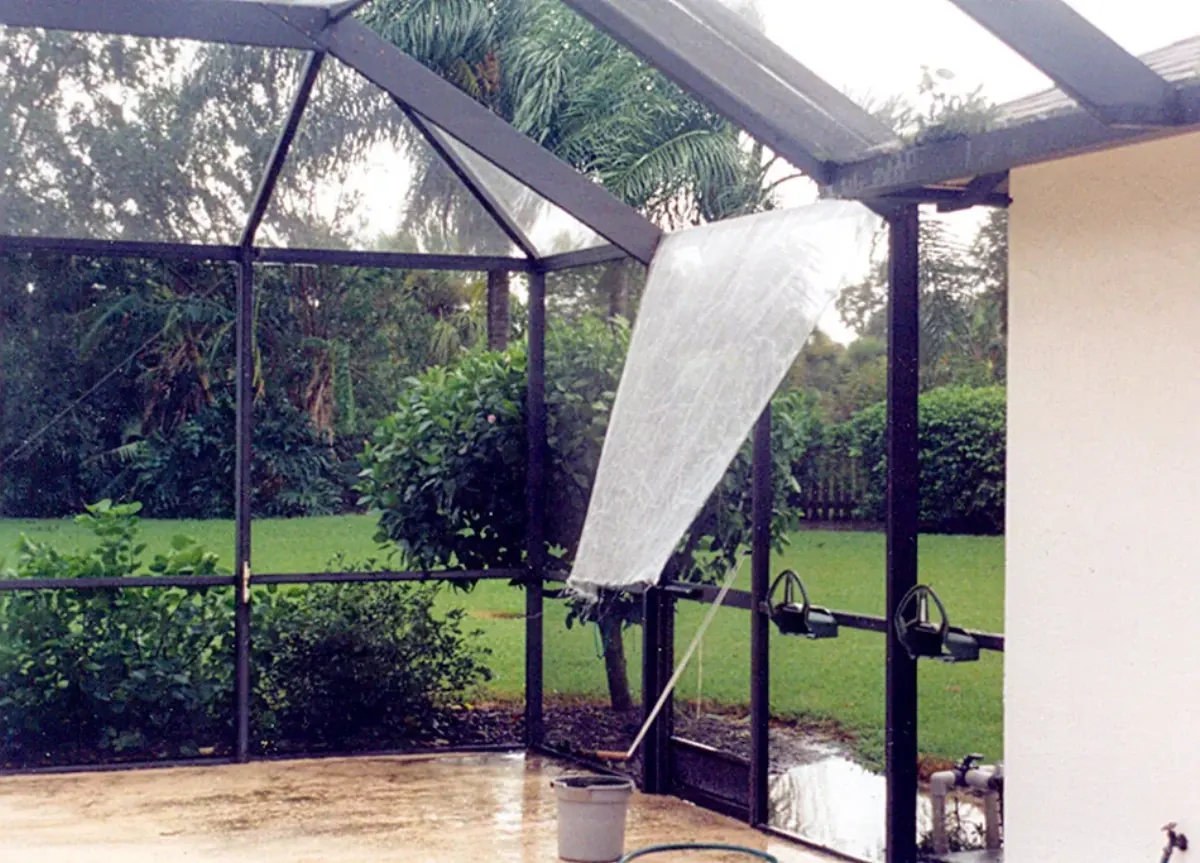
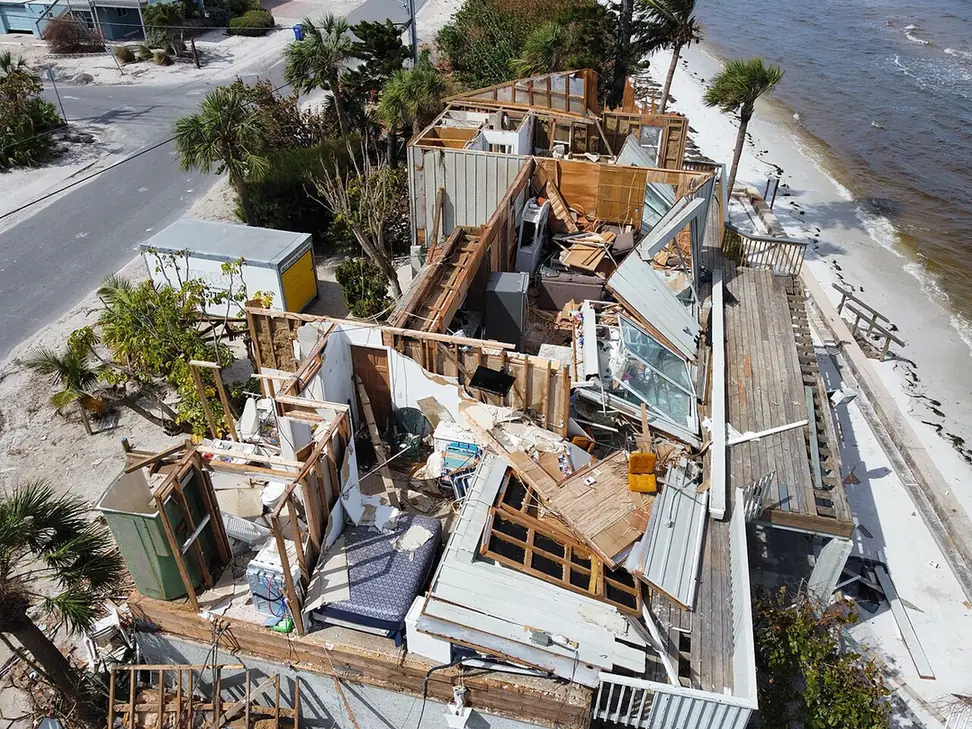
Milton's strongest measured gusts in Tampa Bay were around 93 to 102 mph, well under the 138 to 152 mph design speeds, and pool cages still came apart. Milton made landfall on Siesta Key as a Category 3 hurricane on the night of October 9, 2024, bringing hurricane conditions from Clearwater Beach south to near Venice.
| County | Peak gust reported | Where measured |
|---|---|---|
| Hillsborough | 93 mph | Near Tampa International Airport (most gusts 80 to 100 mph) |
| Pinellas | 101 mph | Albert Whitted Airport, St. Petersburg (most gusts 80 to 100 mph) |
| Manatee | 102 mph | Sarasota-Bradenton International Airport |
| Sarasota | 102 mph; 97 mph | Sarasota-Bradenton International Airport; Venice CMAN |
| Hernando | 76 mph | Brooksville (most gusts 60 to 70 mph) |
| Pasco | 59 mph | Near Zephyrhills (most gusts 55 to 65 mph) |
Swipe the table sideways to see every column →
National Weather Service Tampa Bay, Milton county impact narratives (final, November 22, 2024). The NHC's tropical cyclone report gives the strongest Florida observation as a 93 kt gust at a University of Florida tower at Venice Beach.
In east Manatee County, the Your Observer newspaper reported a Mill Creek resident who heard his pool cage "creaking" before it blew apart, with winds of 100 mph or more measured around Bradenton and Lakewood Ranch. Across the bay, high winds tore the fabric roof off Tropicana Field in St. Petersburg. Milton also spawned 45 known tornadoes on land across Florida.
Why would a cage fail below its design speed? The published sources don't break down individual failures, but the likely factors are the ones the code and research point to: a frame built before current engineering, corroded fasteners, and debris such as branches striking the frame.
Recent hurricanes across Tampa Bay
Four hurricanes from 2022 to 2024 hit the region in different ways: Ian and Milton with wind, Helene and Idalia with storm surge.
| Storm | Landfall | Tampa Bay impact |
|---|---|---|
| Ian, Sept 2022 | Cayo Costa at 130 kt, then near Punta Gorda | Gusts 86 mph at Sarasota-Bradenton airport, 77 mph St. Petersburg, 75 mph Tampa; 21.45 in of rain at North Port; record river flooding in Sarasota and Manatee |
| Idalia, Aug 2023 | Keaton Beach, about 110 n mi west of Tampa | 3 to 5 ft of surge from Chassahowitzka to Englewood including Tampa Bay; gusts 58 to 70 mph; 811 Pinellas structures with major damage |
| Helene, Sept 2024 | Near Perry as a Category 4 | 5 to 7 ft of surge from the Anclote River to Longboat Key; St. Petersburg tide gauge record of 6.31 ft above MHHW; gust 73 mph at Clearwater Beach |
| Milton, Oct 2024 | Siesta Key as a Category 3 | Gusts of 80 to 100 mph across Hillsborough, Pinellas, Manatee and Sarasota; 18.54 in of rain at Albert Whitted; 11.43 in at Tampa International |
Swipe the table sideways to see every column →
NHC tropical cyclone reports for Ian, Idalia, Helene and Milton; NWS Tampa Bay county impact narratives; Bay News 9 and Sarasota Herald-Tribune reporting of NWS figures for Ian.
The NHC also noted that a track shift of less than 30 nautical miles north of Milton's landfall would have brought significant storm surge into Tampa Bay.
Should you cut or remove the screens?
Only if your cage was engineered and labeled for it. Florida's Rule 61G20-1.002, carried into Section 2002.7 of the building code, is an alternative design method that lets the frame be designed on the basis that some screen is removed, retracted, opened or cut in high winds. It comes with strict conditions:
- The cage must be designed with signed and sealed site-specific engineering.
- Screen designated to be cut "shall be completely cut when wind speeds are forecast to exceed 75 mph."
- Panels to be cut or removed must be marked with highly visible permanent labels on the adjacent members.
- Cutting or removing those panels must not require ladders or scaffolding.
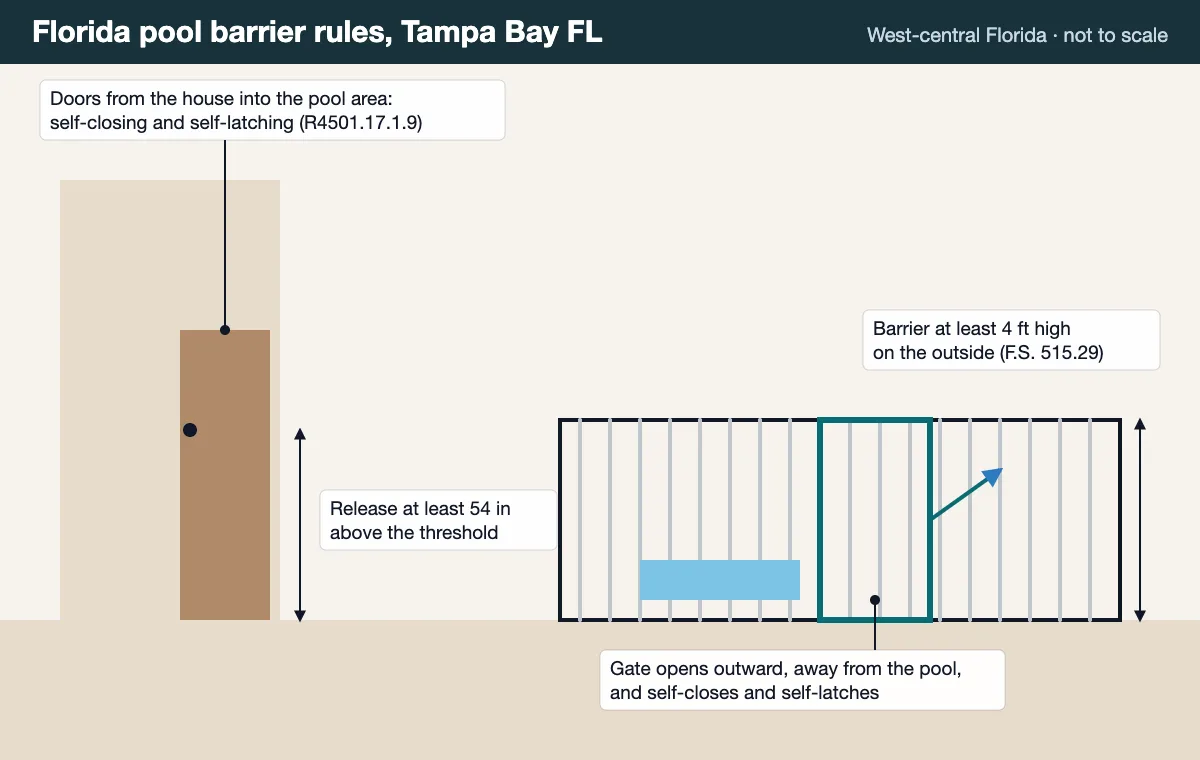
- If the cage is the pool barrier, it must keep its minimum barrier height with those panels cut or removed.
- The contractor must supply replacement screen and spline for a one-time replacement of all screen designed to be cut.
A cage without those labels was designed with its screen in place, under the standard method. There is no code, university or manufacturer source for the common claim that ordinary screens are "designed to blow out" to save the frame. A structural engineering firm that studied the question notes that if screens are only cut, "flapping, half-attached screens would still transfer some stress to the members," and adds that it is not recommending anyone risk their life cutting or removing screens when they should be evacuating or taking shelter.
Where the rule came from
The method was debated when it was proposed. A public comment titled "Designed to Fail?" filed with the Florida Building Commission's Screen Enclosures Workgroup in April 2012 described it as the design of aluminum structures that may ultimately fail under wind, under the alternate method proposed by Senate Bill 704. Today it is an option an engineer may choose, not the default.
Salt air, fasteners and coastal cages
Near salt water, the fasteners deserve the closest look. A University of Florida report to the Florida Building Commission (2017) found corrosion of residential fasteners more serious in coastal environments because of chloride ions, and saw the ceramic coating on stainless steel masonry screws, commonly used for screen enclosures, peel during testing, which may create unlike-metal reactions with aluminum. That matters most on cages near the water in St. Petersburg, Clearwater, Apollo Beach, Bradenton and Venice.
Before hurricane season: a sourced checklist
The checks that matter most are the ones that keep the frame within its design.
- Look for loose, rusted or missing fasteners, especially within sight of salt water, and have them replaced before the season.
- Check for bent or kinked members and torn screen; a bent member is no longer the shape the engineer designed.
- Find out whether your cage has permanent cut-screen labels. If it doesn't, leave the screen alone.
- If you have removable vinyl, glass or acrylic panels, plan to take them out when winds over 75 mph are forecast, as their decal requires.
- Photograph the cage from the ground on a calm day, so you have a record of its condition for a claim.
- Read your policy for a screened enclosure endorsement and your hurricane deductible before a storm is named.
- Never climb onto a cage roof or work at height with a storm approaching.
After the storm: permits and insurance
Structural repairs to a cage usually need a permit, and insurance often won't pay. Pinellas County lists replacing or repairing a pool enclosure or screen room as permitted work after a storm, with fees that the County Commission may waive after a major event. After Milton, Sarasota County suspended permit fees for storm repairs including pool cage repair, and Manatee County waived storm repair permit fees through March 1, 2025. Plant City says non-structural screen damage needs no permit, while structural damage does.
On insurance, Citizens' HO-3 worksheet says screen pool cages and aluminum-framed screened enclosures open to the weather are not covered. Florida's Department of Financial Services describes a screened enclosure endorsement that covers hurricane damage, and Florida law requires insurers to offer hurricane deductibles of $500, 2, 5 or 10 percent of the dwelling limit, applied once per calendar year. Citizens notes you pay that deductible only once in a busy season, even across several named storms.
For repairs, see hurricane damage repair; for a cage beyond saving, pool cage replacement; and for torn panels only, pool cage rescreening. The pool cage insurance guide goes deeper on policies.
Related questions
Are pool cages required in Florida?
No. Florida requires a new residential pool to have at least one of five safety features under Statute 515.27, and a barrier enclosure is only one of them. The Florida pool enclosure requirements guide covers the barrier rules a cage has to meet.
Why do pools in Florida have cages?
Mainly to keep insects out and to serve as the pool barrier. UF/IFAS recommends screens over decks and swimming pools against lovebugs, and Florida has more than 80 mosquito species. See why Florida pools have cages.
Does a new cage cost more because of hurricane code?
Every new cage is engineered to its site's wind speed, and a permit with sealed plans is required, but the peninsula's design speeds have not changed since the 2010 code. The pool cage cost guide has current prices, and the service area page lists every town. You can also request a free quote.