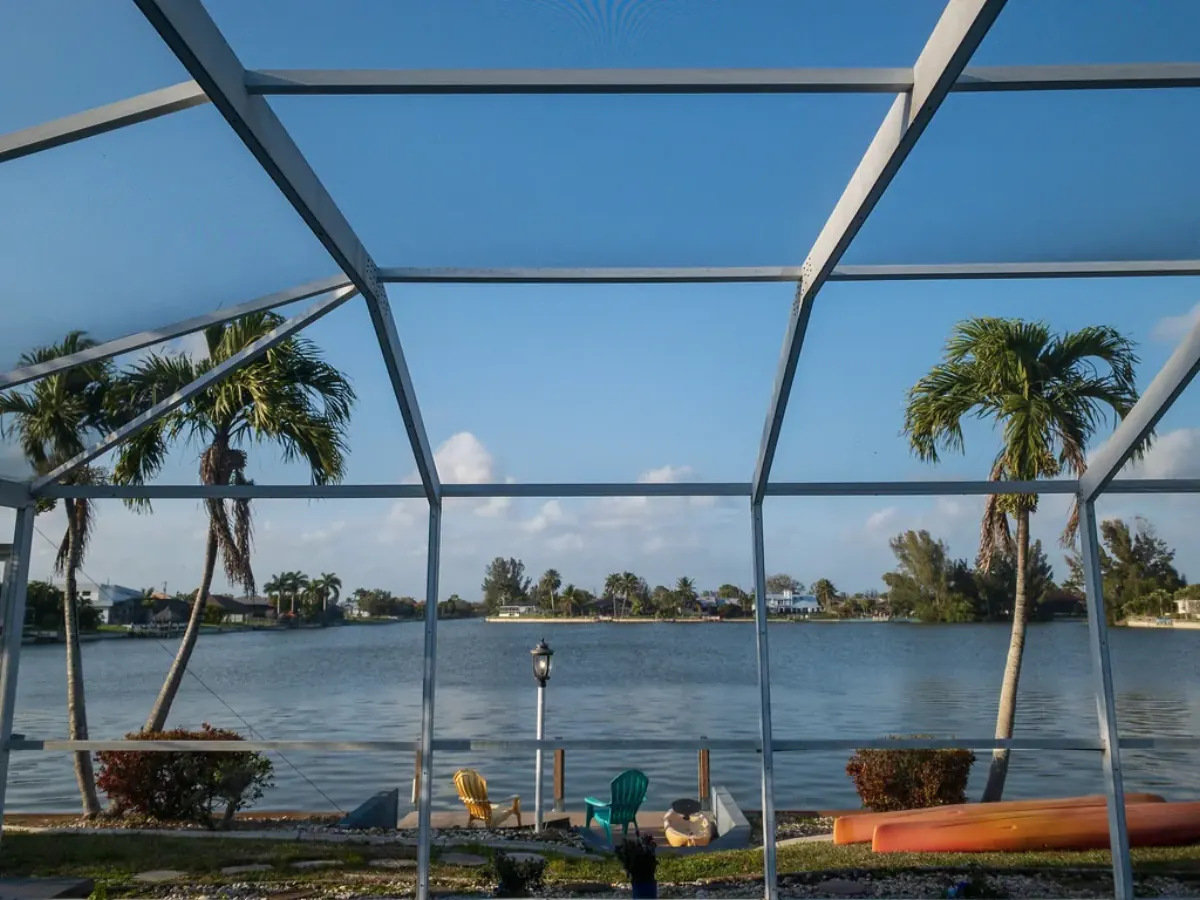
On a screen enclosure in Apollo Beach, FL, salt air puts the fasteners on the watch list right alongside the screen. Apollo Beach is built on water: 55 miles of canals lead to Tampa Bay, and much of the community sits in a mapped flood zone. That changes three things compared with inland Hillsborough County: how cages corrode, how storms hit them and which permit shortcuts are open to you.
It is an unincorporated community of 26,002 people (2020 census) in ZIPs 33570 and 33572, so Hillsborough County issues permits. Housing ranges from the original canal homes that followed the 1958 founding to newer master-planned communities like Waterset, MiraBay and Symphony Isles.
Salt air and Apollo Beach pool cages
Corrosion is the main reason waterfront cages fail early, and it starts at the screws. A University of Florida report to the Florida Building Commission found fastener corrosion more serious in coastal environments because of chloride ions from salt air. It also found that the ceramic coating on stainless steel masonry screws, commonly used on screen enclosures, peeled during testing, which can create unlike-metal reactions when those screws sit in aluminum.
What to look for on a canal or bay lot
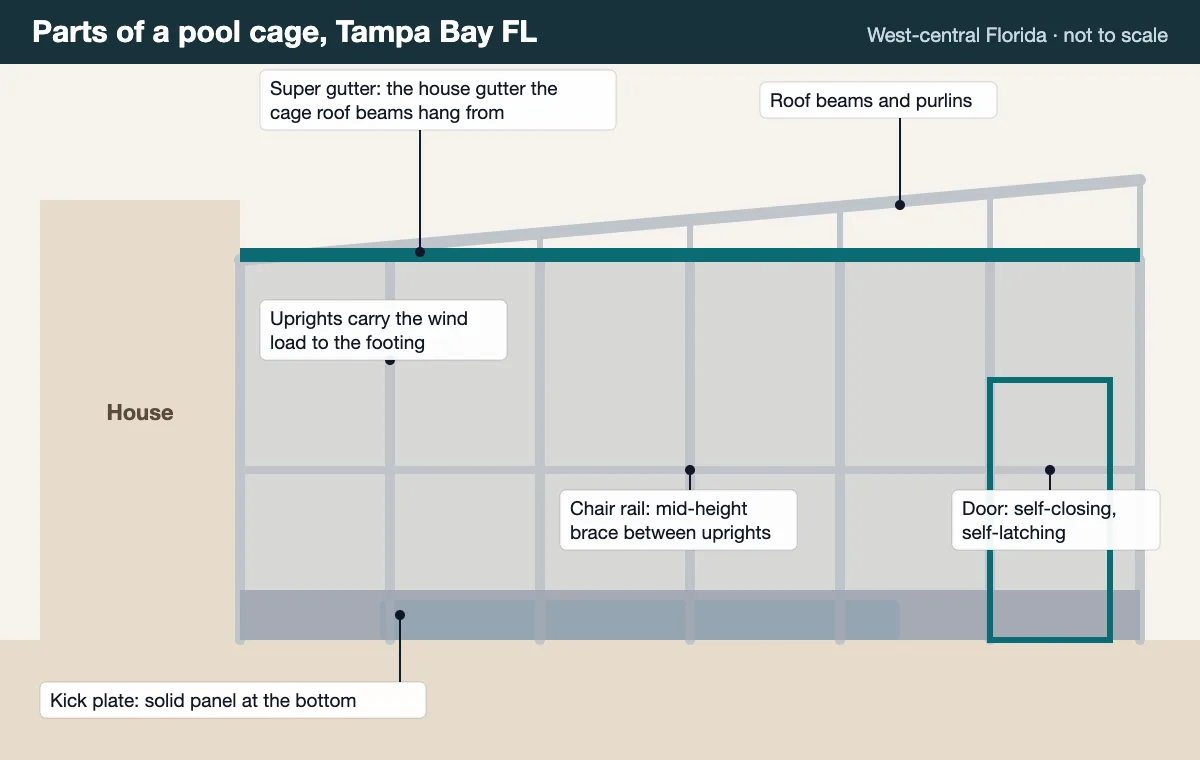
- Rust streaks or white powder around screw heads on posts and beams
- Screws that spin or pull out where the cage meets the deck or the house
- Pitting or bubbling paint on the frame, worst on the side facing the water
- Kick plates and door hardware seized or flaking
- A super gutter streaked or pitted along its seams
Published Tampa Bay figures put a full fastener refresh at $800 to $2,400, or $1,000 to $3,400 combined with a rescreen (September 2026). Catching it at the fastener stage is far cheaper than pool cage replacement at $12,000 to $25,000 or more. A faded frame with sound metal is a candidate for pool cage painting, which seals the finish again.
Apollo Beach local facts
Apollo Beach's coastal setting shows up in nearly every row of this table.
| Topic | Apollo Beach fact |
|---|---|
| Status | Unincorporated census-designated place, Hillsborough County permits |
| Water | 55 miles of canals leading to Tampa Bay |
| Flood risk | Much of Apollo Beach sits in a mapped flood zone |
| Evacuation | Zone A |
| Hurricane Helene, 2024 | Storm surge along the canals; 5 to 7 ft of inundation within Tampa Bay (NHC) |
| Peak water, Helene | 7.2 ft above MHHW at East Bay, Hillsborough County (NWS) |
| Corrosion | Salt air makes fastener corrosion more serious (UF study) |
| Big communities | Waterset (planned for 3,800 homes on about 1,300 acres), MiraBay, Symphony Isles |
| Main roads | US 41 through the center, I-75 on the east, Big Bend Road |
Swipe the table sideways to see every column →
Compiled from Census 2020 data, the NHC Helene tropical cyclone report, NWS Tampa Bay Helene county narratives, Fox 13 and WUSF Helene coverage, a UF report to the Florida Building Commission (2017), 83 Degrees Media on Waterset and a local pool builder's flood-zone notes, fetched 2026-10-13.
Original canal homes vs newer communities
Apollo Beach cages come in two generations, and they usually need different jobs. The community dates from 1957, when Francis Corr, a retired Michigan businessman, bought the land; it took the name Apollo Beach in 1958. Canal homes from the decades that followed carry cages built under older rules.
Waterset, which Newland began around 2012 on about 1,300 acres off Big Bend Road, roughly 15 miles south of Tampa, is planned for 3,800 homes. Its oldest cages are now past a decade old. With fiberglass screen lasting about 5 to 10 years in Florida, many are due for their first full rescreen, while the frames are still young.
- Older canal home: start with the fasteners and anchors, then decide between rescreening and replacement.
- Newer Waterset, MiraBay or Symphony Isles home: usually a rescreen, with HOA approval for any color change.
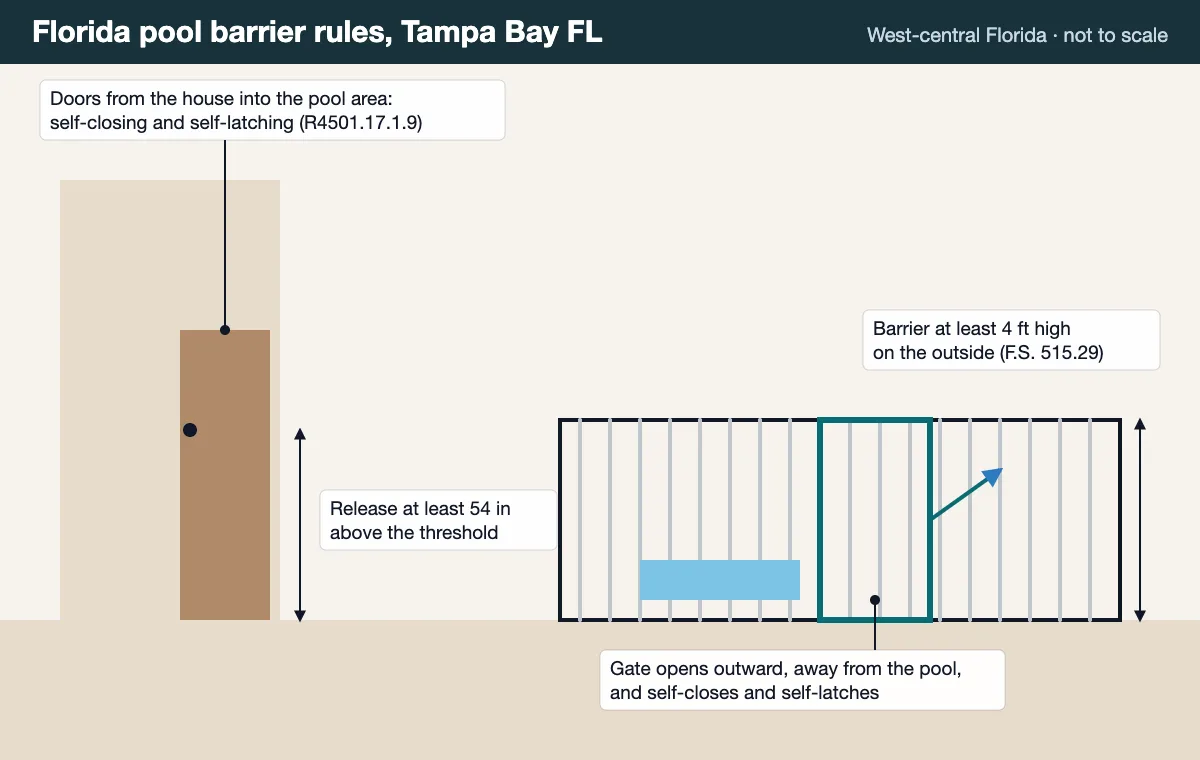
- Either one, if the cage is the pool barrier: doors that open outward, self-close and self-latch (FS 515.29).
Helene, Milton and the surge question
Helene in 2024 brought storm surge into Apollo Beach's canal neighborhoods, and Milton two weeks later nearly did worse. One resident said Helene filled the inside of the house with four feet of water, and flooding in Apollo Beach and Ruskin damaged wastewater pumping systems. The National Hurricane Center measured 5 to 7 feet of surge inundation within Tampa Bay. For Milton, it noted that a track shift of less than 30 nautical miles north of the actual landfall would have pushed significant surge into Tampa Bay.
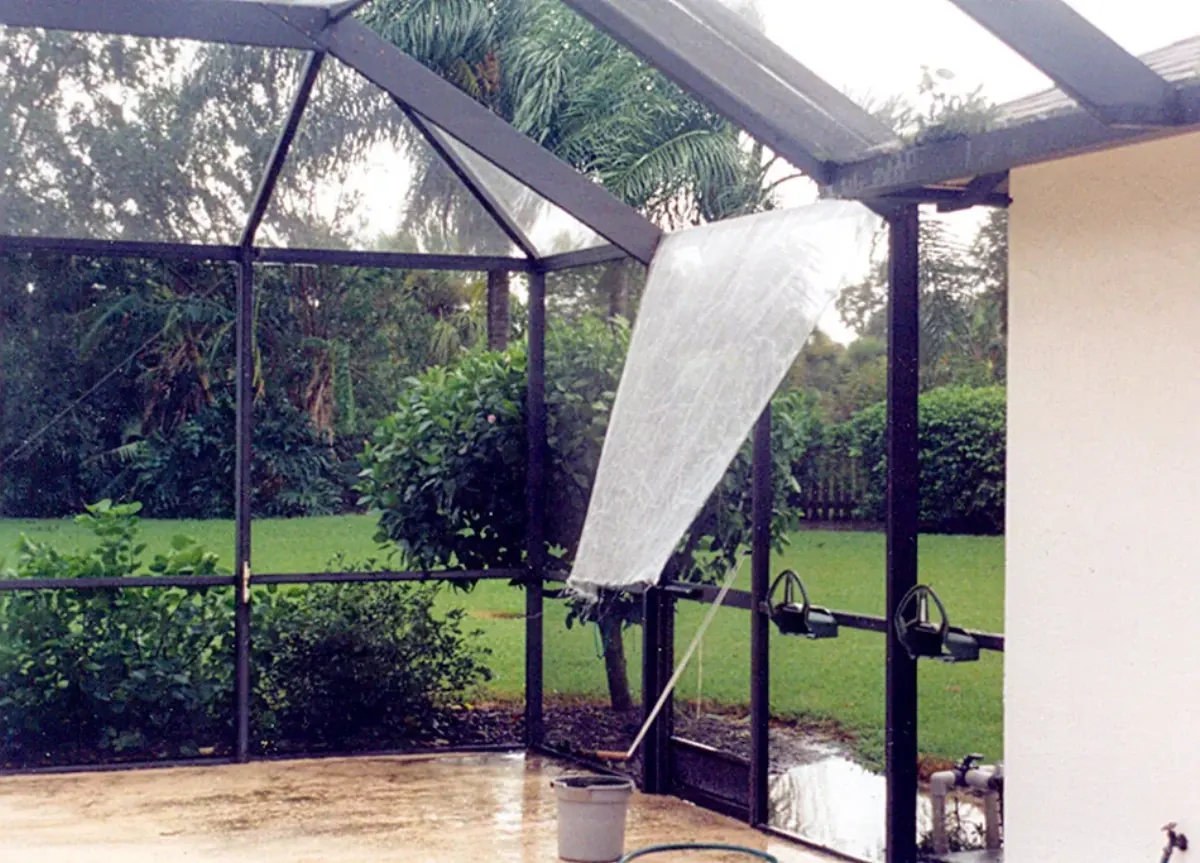
After a surge, have the anchors and fasteners checked before paying for new screen. Salt water sitting at the base of the posts is the same chloride problem the UF fastener study describes, only more of it.
Flood zones and Apollo Beach permits
Apollo Beach permits come from Hillsborough County, and flood-zone status matters more here than almost anywhere in the county. Florida's new exemption for single-family work under $7,500 (Statute 553.79, from July 1, 2026) excludes property partly or entirely in a flood hazard area, and it never covers structural work. On many Apollo Beach lots, that shortcut simply doesn't exist.
A new cage needs the county's Residential Miscellaneous Permit with plans signed and sealed by a Florida architect or engineer, a site plan showing easements and setbacks (on canal lots, seawall setbacks can come into it) and a recorded Notice of Commencement. The published fee is $380. In the master-planned communities, a local pool builder notes that MiraBay, Waterset and Symphony Isles run architectural review on screen enclosures, so that approval comes first.
Full county details are in the Tampa Bay pool enclosure permit guide.
Screen choices for canal and bay homes
For waterfront Apollo Beach, Phifer's 20x20 No-See-Um mesh is the screen built for the problem. Phifer describes it as a tightly woven mesh for no-see-ums, gnats, sand flies and other bugs from marshy or coastal areas, the insects that slip through standard 18x14.

- 20x20 No-See-Um: about $10 to $20 more per panel than standard mesh (Central Florida, 2026).
- TuffScreen: heavy-duty vinyl-coated polyester for high-traffic walls.
- Glas-Shield: vinyl-laminated mesh below the chair rail and on privacy walls, not roofs.
- Mixed: No-See-Um on the water side, standard mesh elsewhere, to manage cost.
The screen types guide compares visibility and wear.
Apollo Beach costs
Waterfront building costs more: one Tampa Bay guide prices coastal cages at $18 to $25 per square foot, against a general range of $12 to $25. Other published figures:
| Job | Range | Source and date |
|---|---|---|
| Single panel | $75 to $150 | Tampa Bay contractor guide, Jan 2026 |
| Full rescreen | $1,500 to $4,500+ | Florida contractor price guide, Dec 2025 |
| Large two-story cage, 20x20 No-See-Um | $4,500 to $7,500+ | Tampa Bay contractor guide, Mar 2026 |
| Fastener refresh, no rescreen | $800 to $2,400 | Tampa Bay contractor guide, Sep 2026 |
| New cage, coastal | $18 to $25 per sq ft | Tampa Bay contractor guide, Feb 2026 |
| New cage, typical projects | $10,000 to $30,000+ | Tampa Bay contractor price list, 2026 |
| Full replacement | $12,000 to $25,000+ | Tampa Bay contractor guide, Jan 2026 |
Swipe the table sideways to see every column →
Compiled from published contractor price pages, fetched 2026-10-13. Planning ranges, not quotes.
More detail is in the pool cage cost guide. For a sound frame, pool cage rescreening is the usual job; for a new build, pool enclosure installation. Nearby Sun City Center and Ruskin and Riverview have their own pages, and every town is on the service area page. Get a free quote when you're ready.