Last reviewed October 2026. Statute and code text quoted from Florida Statutes chapter 515 and the 2023 (8th Edition) Florida Building Code.
Florida does not require a pool enclosure. It requires every new residential pool to have at least one approved safety feature, and a barrier that fully surrounds the pool, such as a screen cage, is one of those options. That is the core of the pool enclosure requirements Florida sets, and it is the same in Tampa, Clearwater, Bradenton or Spring Hill. If you do build a screen enclosure, it then has to meet two more sets of rules: the barrier specs in the statute, and the Florida Building Code's structural and wind rules for aluminum.
On top of the state rules, Tampa Bay counties and cities set their own setbacks, and many HOAs control frame color, screen color and roof shape. This guide covers each layer in order.
What the Residential Swimming Pool Safety Act requires
To pass final inspection, a new residential pool must have at least one of the safety features listed in Florida Statute 515.27(1). Leaving a new pool without one is a second-degree misdemeanor under the statute.
| Option | What it requires | Where an enclosure fits |
|---|---|---|
| Barrier enclosure | The pool is isolated from the home by an enclosure that meets section 515.29 | A screen cage or fence meeting 515.29 qualifies |
| Safety pool cover | An approved safety pool cover | Independent of any enclosure |
| Exit alarms | Alarms on all doors and windows with direct access to the pool, at least 85 dB A at 10 feet | Often added where the house wall is part of the barrier |
| Self-closing doors | All doors with direct access to the pool are self-closing, self-latching, release no lower than 54 inches above the floor | Applies to house doors that open into the cage |
| Pool alarm | A swimming pool alarm meeting ASTM F2208 | Independent of any enclosure |
Swipe the table sideways to see every column →
Florida Statutes 515.27(1), read 2026-10-13. The statute defines a young child as anyone under 6 years old (515.25).
That is why a cage alone may not finish the job: when the back wall of the house is part of the barrier, every door from the house into the cage is a way to the pool. Florida Statute 515.29 says a dwelling wall can be part of the barrier only if it has no door or window that opens to give access to the pool.
Florida pool barrier requirements (515.29)
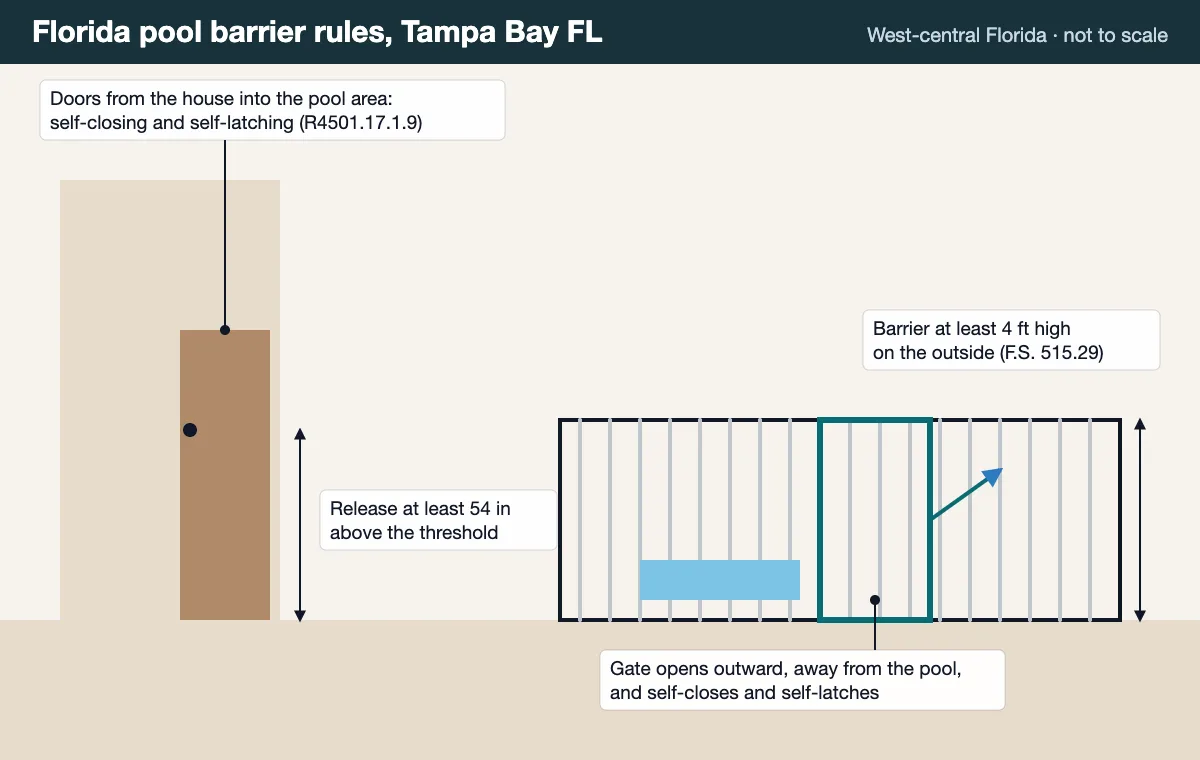
A pool barrier in Florida must be at least 4 feet high on the outside and have no openings a young child could use. Section 515.29 sets these rules, whether the barrier is a fence, a wall or a screen enclosure:
- Height: at least 4 feet, measured on the outside of the barrier.
- No gaps, openings, indentations, protrusions or structural parts that would let a young child crawl under, squeeze through or climb over.
- Gates open outward, away from the pool.
- Gates are self-closing and have a self-latching locking device.
- The latch release is on the pool side of the gate, placed so a young child can't reach it over the top or through a gap.
- A house wall can be part of the barrier only if no door or window in it opens onto the pool.
When a screen enclosure counts as the barrier
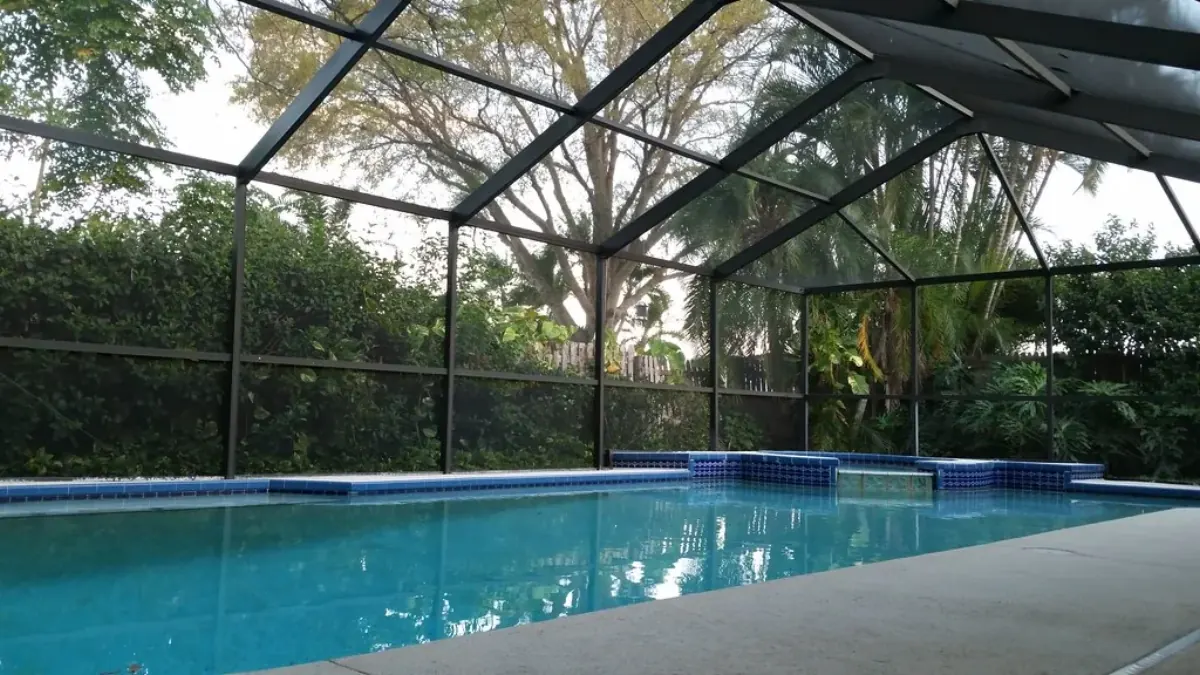
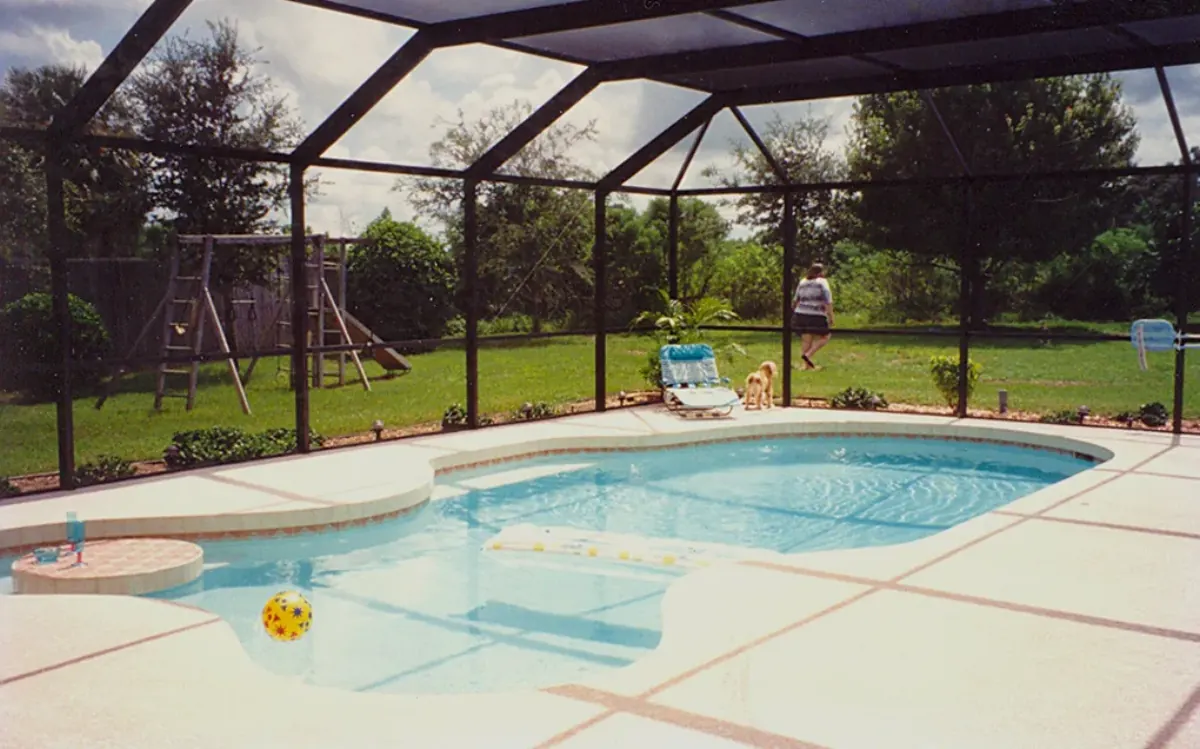
A screen pool cage can be part or all of the required barrier, under Florida Residential Code section R4501.17.1.11: "Standard screen enclosures which meet the requirements of Section R4501.17 may be utilized as part of or all of the 'barrier' and shall be considered a 'nondwelling' wall." The statute itself never uses the words screen enclosure; the code is what connects the two.
What that means for a cage
- Screen doors in the cage wall act as gates in the barrier, so they must swing out, self-close and self-latch.
- Doors from the house into the cage need their own safety feature: R4501.17.1.9 calls for self-closing, self-latching devices with positive mechanical latching at least 54 inches above the threshold.
- Torn or missing lower panels can leave exactly the kind of opening 515.29 rules out.
- If the cage was engineered with screens designed to be cut or removed before a storm, the code requires the barrier to keep its minimum height even with those panels cut or removed.
Two local codes make this concrete. New Port Richey requires all screen enclosure doors to swing out, self-close and self-latch, with latches at least 54 inches from the exterior landing. Pasco County's land development code says pool screen enclosures cannot be torn or in disrepair anywhere up to 4 feet from grade.
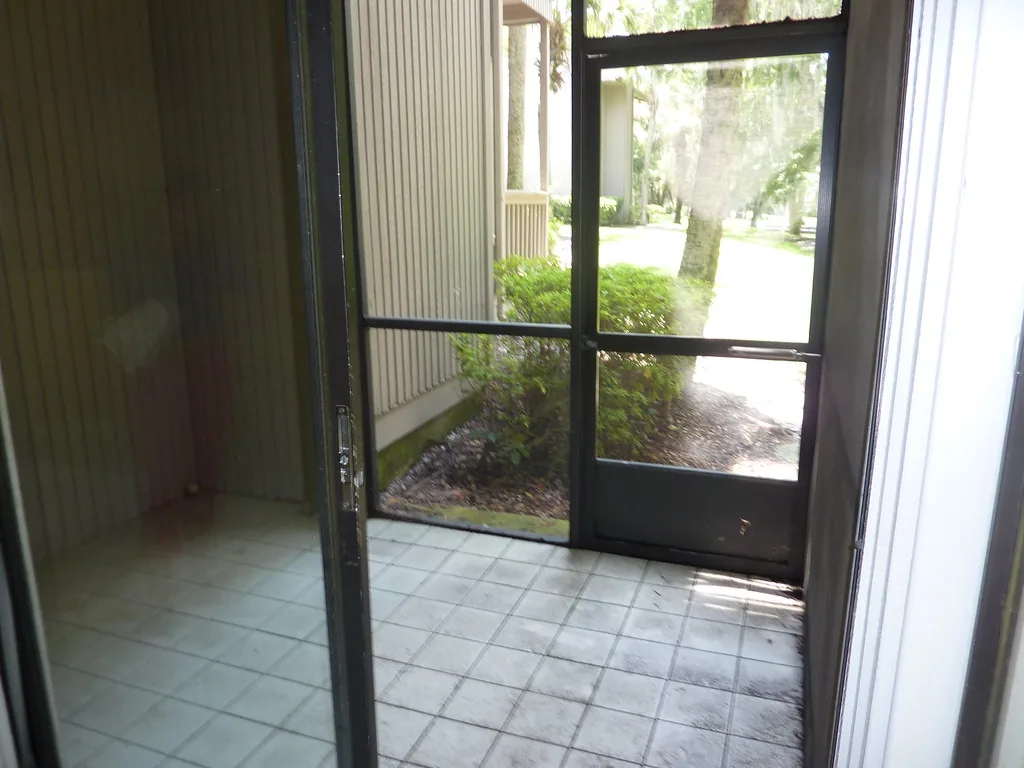
Worn door closers and latches that no longer catch undo the barrier on an older cage. That work is covered on the pool cage door replacement page, and torn lower panels on pool screen repair.
Structural and wind requirements for the enclosure
A Florida pool enclosure is a structure, and Section 2002 of the Florida Building Code sets how it is built. The key requirements in the 2023 (8th Edition) code:
| Requirement | What the code says | Section |
|---|---|---|
| Minimum wall thickness | Extruded aluminum members at least 0.040 inch (1 mm) thick | 2002.3.1 |
| Wind design | Members designed for wind in two directions using the pressures in Table 2002.4 | 2002.4 |
| Design speeds | Table 2002.4 covers ultimate wind speeds of 110 to 170 mph in exposures B, C and D | Table 2002.4 |
| Point load | Each primary member carries 300 lb applied downward along any 1 ft | 2002.4 |
| Design guide | The AAF Guide to Aluminum Construction in High Wind Areas is accepted engineering practice | 2002.4.1 |
| Removable panels | Vinyl, glass or acrylic removable panels carry a decal: remove when winds exceed 75 mph | 2002.3.3 |
| Screen removal design | Optional cut or remove-screen design needs sealed site-specific engineering | 2002.7 |
Swipe the table sideways to see every column →
Florida Building Code, Building, 8th Edition (2023), Chapter 20, Section 2002. The building official may also require any aluminum structure to be designed by a Florida-registered professional engineer.
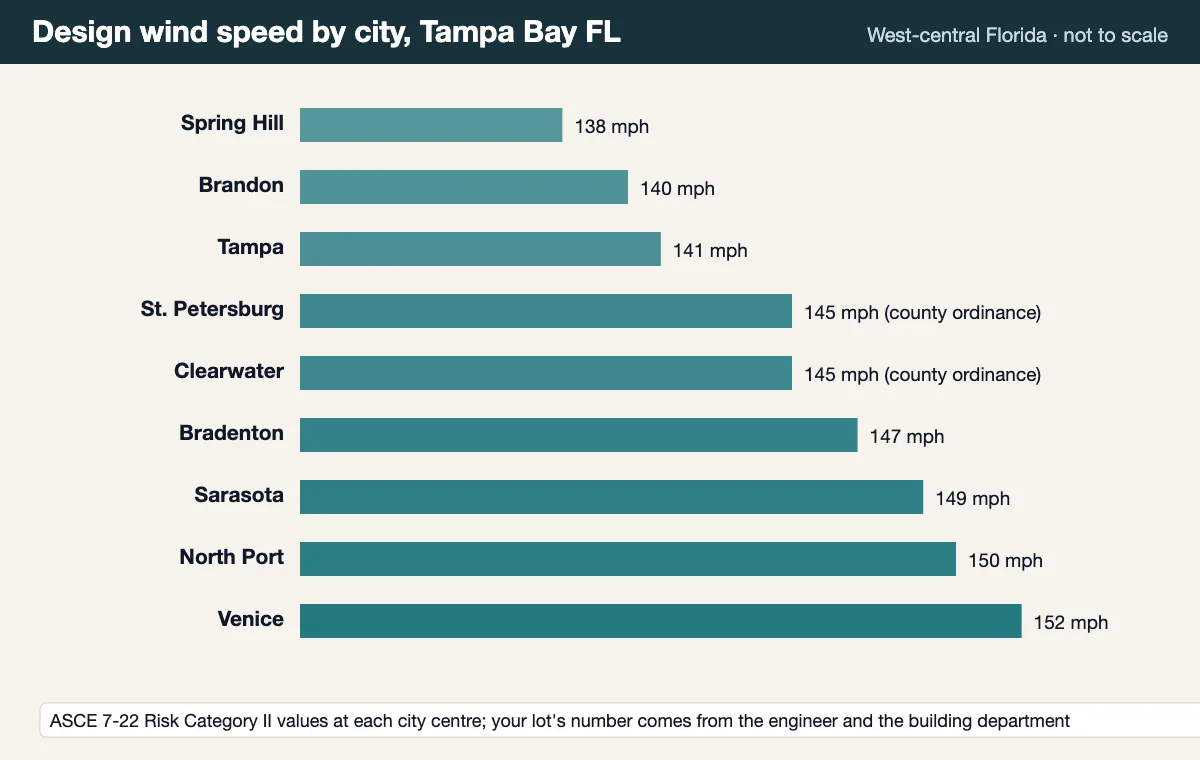
Design wind speeds differ across the region, from about 138 to 140 mph inland in Pasco and Hernando to 145 mph in Pinellas (set by county ordinance) and roughly 149 to 152 mph around Sarasota, Venice and North Port. The hurricane guide has the table and explains what those numbers mean for a cage.
Permits and licensing
A new pool enclosure needs a building permit and, in most Tampa Bay jurisdictions, plans signed and sealed by a Florida architect or engineer. The state's new $7,500 permit exemption does not help, because it excludes structural work. Screen enclosure work falls under Florida's Specialty Structure Contractor license (rule 61G4-15.015), which covers screened porches, screened enclosures and pool enclosures, and Hillsborough and Pinellas add their own local licensing and registration. The Tampa Bay pool enclosure permit guide lists fees, portals and rescreen exemptions for all 22 jurisdictions.
Setback and placement rules in Tampa Bay
Most Tampa Bay jurisdictions that publish a rule keep pool cages at least 5 feet from side and rear lot lines. The details vary, especially on waterfront and corner lots:
| Jurisdiction or community | Rule | Source |
|---|---|---|
| Pasco County (unincorporated) | At least 5 ft from side and rear property lines | Land Development Code sec. 530 |
| Manatee County | 5 ft from side and rear lines; no cage in easements or drainage swales | County permitting section |
| New Port Richey | At least 5 ft from side and rear lines; waterfront yards up to 10 ft into the setback, see-through materials | LDC 12.04.2.e |
| Temple Terrace | Accessory uses no nearer than 5 ft to any property line | City accessory structures page |
| City of Sarasota | No cage between the front of the house and the street; corner lots have two fronts | City pool permit requirements |
| Hillsborough County | Site plan must show all easements, conservation or wetland areas and setbacks | Screen enclosure checklist |
| Westchase (HOA) | 5 ft from a rear or wetland setback line, 3 ft from a side lot line | Westchase residential guidelines, 2022 draft |
Swipe the table sideways to see every column →
From each jurisdiction's or association's published rules, read 2026-10-13. The Westchase row is from a 2022 draft amendment; the full current guidelines could not be retrieved.
The City of Sarasota also asks for extra cross-section drawings for pools inside its 30-foot waterfront setback with a seawall. Wetland setback lines in Westchase are recorded on the plats, and pool facilities that cross a Hillsborough County wetland setback line need the county's specific approval.
HOA rules on pool enclosures
Many Tampa Bay HOAs require written approval before a cage goes up and limit frame color, screen color and roof style. These are the published rules we could verify:
| Community | Frame and screen | Other rules |
|---|---|---|
| FishHawk Ranch (Lithia) | Bronze, white or black frame; charcoal screen | Prior written approval; landscaping where visible from a flanking street |
| Seven Oaks (Wesley Chapel) | White or bronze frame; charcoal screen | No mill-finish aluminum; no flat roofs |
| Meadow Pointe (Wesley Chapel) | White or brown frame; smoke or gray screen | District architectural review before any improvement |
| Westchase | White or bronze frame; charcoal screen | Florida Glass-type privacy screen on no more than 40% of screen height |
| Starkey Ranch (Odessa) | Per design guidelines | Board approval for screened enclosures; Florida Glass needs approval |
| Lakewood Ranch, Country Club and Edgewater villages | Charcoal 18x14 or 20x20 fiberglass or PVC-coated | Square or rectangular; mansard roof over 100 sq ft; no curved roofs; not above the house; not seen from the street |
| Venetian Golf & River Club (Venice) | Bronze frame; charcoal screen; bronze super gutters | Deviations only with prior approval |
| Twin Lakes of Brandon | Per association rules | Written Architectural Committee approval before installation |
| Panther Trace II (Riverview) | Color and material approved by the ARC | ARC design guidelines (2020) |
Swipe the table sideways to see every column →
From each association's recorded rules, design standards or manuals, read 2026-10-13. Rules are amended; get your association's current version before you apply.
What about glass pool enclosures?
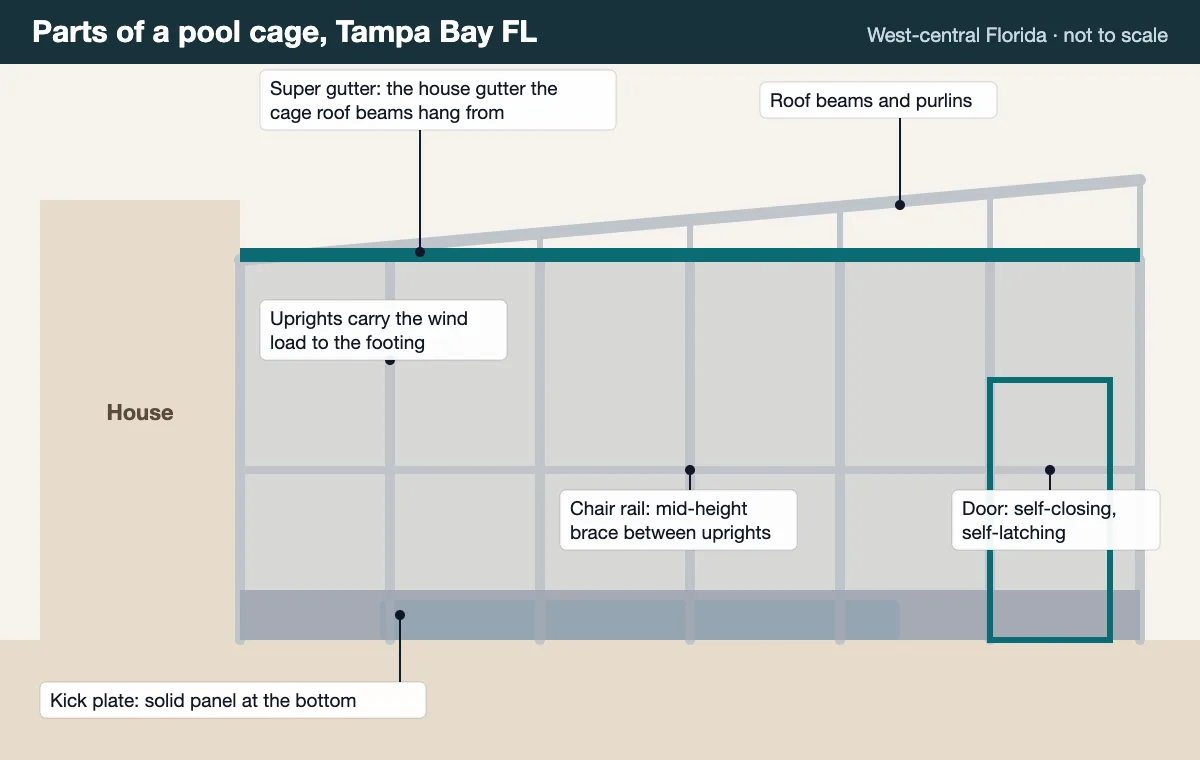
What many Floridians call a glass pool enclosure is usually screen, not glass. Phifer's Glas-Shield, often sold as Florida Glass, is a vinyl-laminated 18x14 fiberglass screen made for the lower panels below the chair rail, where it keeps dirt and debris out, and for privacy walls. Phifer says it is not made for roofs. Several HOAs regulate it: Westchase caps it at 40 percent of the screen height and Starkey Ranch requires approval first.
True glass rooms are a different structure under the code. Hillsborough County's checklist covers screen enclosures and glass room additions together, and removable vinyl, glass or acrylic panels in an enclosure must carry the code's decal telling owners to remove them when winds exceed 75 mph.
Why so many Florida pools are screened
Insects first, safety second. UF/IFAS's guide to living with lovebugs recommends screens "placed over decks and swimming pools," and lovebugs swarm across Florida every April to May and August to September. Florida also has more than 80 mosquito species, and UF/IFAS Extension in Sarasota County notes mosquito numbers run much higher in the June 1 to September 30 rainy season. A cage that meets the barrier rules doubles as the pool's safety feature. The why Florida pools have cages guide covers the reasons in more depth.
Pool enclosure requirements checklist
Before a new cage, or before relying on an old one as your pool barrier, check each of these:
- The pool has at least one 515.27 safety feature, and you know which one it is.
- If the cage is the barrier: at least 4 feet high outside, no gaps, every cage door swings out, self-closes and self-latches.
- Every house door into the cage has a self-closing, self-latching device at 54 inches or higher, or an exit alarm.
- Lower screen panels are intact, especially in Pasco County where the code requires it up to 4 feet.
- The setback from side and rear lines meets your county or city rule, usually 5 feet.
- HOA approval is in writing for frame color, screen color and roof style.
- A building permit and engineered plans are in place for any new or structural work.
- The contractor holds a Florida Specialty Structure license or the local equivalent.
Ready to build? See pool enclosure installation and pool cage rescreening, check the service area, or request a free quote.