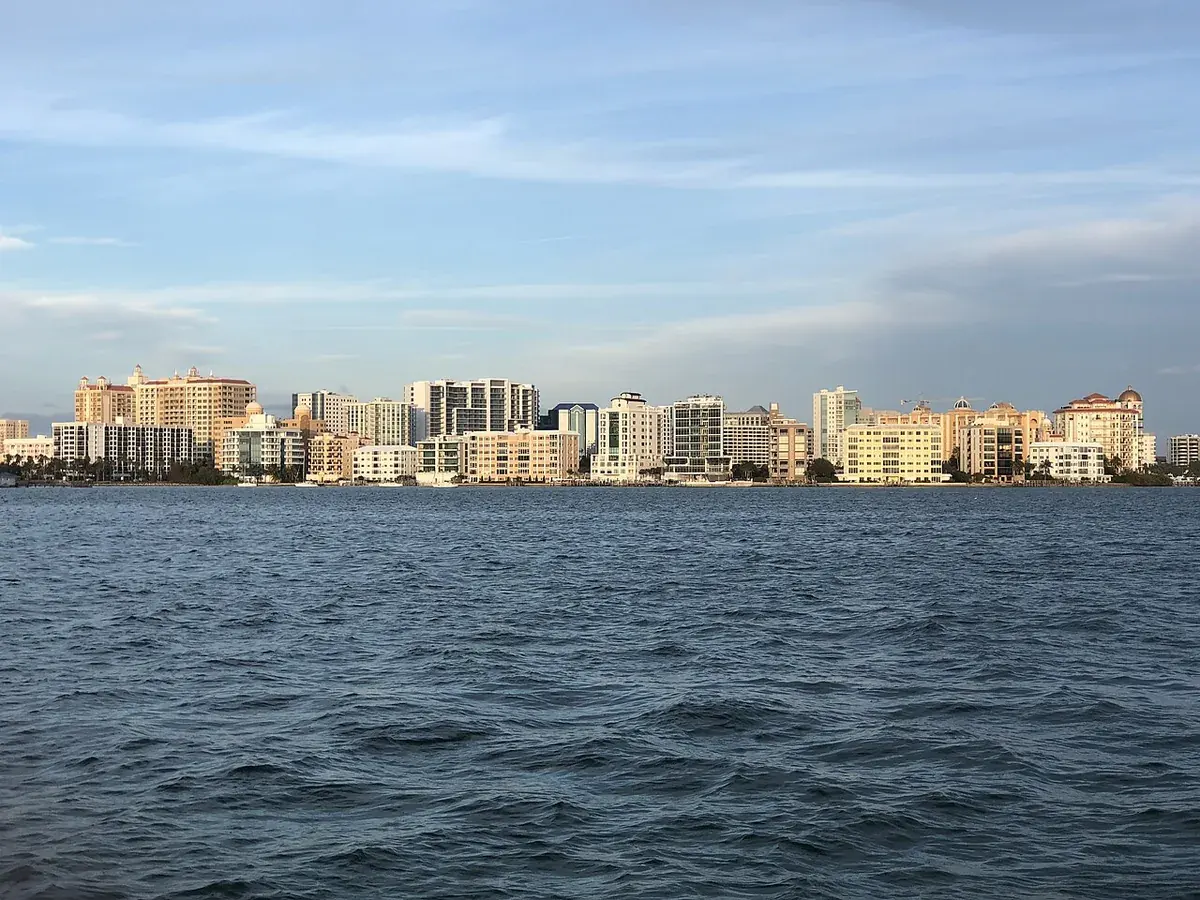
Sarasota, FL has two permit offices for screen enclosures, and the city one has a placement rule most of Tampa Bay does not: no pool cage between the front of the house and the street. The City of Sarasota, population 54,842 at the 2020 census, sits on Sarasota Bay and takes in Lido Key, St. Armands Key, Bird Key and the northern part of Siesta Key. Homes with a Sarasota address outside city limits, such as Palmer Ranch, answer to Sarasota County instead.
This page gathers the screen enclosure Sarasota FL owners need before they spend money on a cage: city and county rules side by side, published prices, screen choices for salt air, what Milton, Helene, Idalia and Ian did here, and how to judge a frame that has been through all four.
Where you are in Sarasota changes the job
Island and bayfront homes face salt, surge and the city's waterfront drawing rules; inland county neighborhoods face wind, rain and a different permit office. A few examples:
- Lido Key, St. Armands Key and Bird Key: inside city limits, across Sarasota Bay from downtown. Helene buried Benjamin Franklin Drive on Lido in sand and left St. Armands under water, so cages here deal with salt and flooding as much as wind.
- Siesta Key: the northern part is in the city and the rest is in the county. Milton came ashore here, so the permit office depends on which part of the key you are on.
- Downtown and the mainland neighborhoods: city rules apply, including the front-yard placement rule and the 30-foot waterfront setback drawings for pools near a seawall.
- Palmer Ranch: a planned community of 14,966 people on about 6,733 acres between Sarasota and Osprey, bounded by Clark Road, US 41 and I-75, and established in 1984. It is unincorporated, so Sarasota County issues permits there.
Inland, Ian showed the flood side of the risk in 2022, when the Myakka River shut a stretch of I-75 in southern Sarasota County. Low-lying lots near the river carry the same flood-zone limits on permit exemptions that the keys do.
City of Sarasota vs Sarasota County
Both offices require a permit for a new screen enclosure; neither names rescreening on its no-permit list; only the city restricts where the cage can go on the lot. The table pulls together what each one publishes.
| Item | City of Sarasota | Unincorporated Sarasota County |
|---|---|---|
| Permit office | City Building Division (FTG Portal) | Planning & Development Services (Accela) |
| New screen enclosure | Permit, with the city's aluminum construction plan requirements | Permit for any construction, alteration or addition |
| Engineering | Signed and sealed plans, or the engineer's name and title of an engineered specification the contractor is authorized to use | Not stated in the guidelines checked |
| Copies to submit | Five copies of the listed documents | Online through Accela |
| Pool cage placement | Not between the front facade and the street; corner lots have two fronts | Check zoning for the lot |
| Waterfront pools | Inside the 30-foot waterfront setback with a seawall, extra cross-section drawings | Check zoning for the lot |
| Small repairs | No permit for non-structural repairs under $1,000 | Some no-permit items still need a licensed contractor |
| Rescreen only | Not named; ask | Not named; ask |
| Flood zone | HB 803 exemption does not apply | Exempt items need a permit in a flood zone |
| After Milton (Oct 2024) | Not published in the sources checked | Permit fees suspended for storm repairs, including pool cage repair |
| Design wind (ASCE 7-22, Risk Cat. II) | About 149 mph at city center | Varies by site; confirm for the address |
Swipe the table sideways to see every column →
Compiled 2026-10-13 from the City of Sarasota's Minimum Plan Requirements for Aluminum Construction (updated 01/21), its pool minimum requirements and 'when a building permit is needed' ordinance, Sarasota County's Building Permit Guidelines (updated August 2026), WGCU's post-Milton permit report (Oct 24, 2024) and the ASCE 7-22 wind geodatabase. Confirm with your building department for your parcel.
The city's front-yard rule for pool cages
Inside the City of Sarasota, a pool cage has to stay behind the front facade of the house, and on a corner lot it has to stay behind both fronts. The rule appears in the city's minimum requirements for pool permits, which also note that a corner lot counts as having two front facades, so the cage cannot extend past either one.
That matters most in two situations. On a corner lot, the side yard that faces the second street is off limits, which can shrink the space for a pool and cage to the true rear corner. On a bayfront or canal lot, where the pool is often placed toward the water, the same document requires extra cross-section drawings for any pool inside the 30-foot waterfront setback where there is a seawall. Settle both questions on the site plan before engineering is ordered.
- Mark both street frontages if you are on a corner; the cage stays behind each facade line.
- If the pool sits inside 30 feet of a seawall, expect the cross-section drawings the city asks for.
- Keep the cage clear of easements shown on your survey.
- Check any HOA or condo rules on frame and screen color before the drawings are final.
What screen enclosures cost in Sarasota
Rescreening runs about $1,500 to $4,500 for most cages, a new engineered cage $10,000 to $30,000 or more, and a full storm replacement $12,000 to $25,000 or more. Size and height drive most of the spread. Two published tables give a feel for it: one by cage size and story, one by screen product.
| Cage size | One-story cage | Two-story cage |
|---|---|---|
| 15 x 30 ft | $900 to $2,100 | $1,500 to $3,200 |
| 20 x 40 ft | $1,500 to $3,500 | $2,000 to $4,600 |
| 30 x 50 ft | $2,100 to $5,000 | $3,000 to $7,000 |
Swipe the table sideways to see every column →
National cost guide table, page dated September 2023 and fetched 2026-10-13. Florida contractors quote similar whole-cage totals, $1,500 to $4,500+ (Dec 2025 and Mar 2026). Two-story cages run up to 30 percent more.
| Screen | Per sq ft of screen | Typical full-cage total |
|---|---|---|
| Fiberglass | $0.75 to $1.25 | About $900 to $1,600 |
| Polyester | $1.20 to $1.80 | About $1,500 to $2,200 |
| Pet-resistant | $1.50 to $2.50 | About $2,000 to $3,000+ |
| Solar screen | $1.80 to $3.00 | About $2,700 to $4,500 |
Swipe the table sideways to see every column →
One Florida contractor's published cost guide, December 2025, fetched 2026-10-13. Material-only per-square-foot figures are lower than the installed $1.50 to $3.50 per sq ft other Florida guides quote, so use the totals.
Other Sarasota jobs and their published prices
- Minor screen repairs: $200 to $600, or about $50 to $150 per panel (a Sarasota-area company).
- Upper panel on a two-story or mansard cage: $60 to $120 per panel (Florida, 2026).
- Door rebuild or replacement: $250 to $650 per door with hardware (Florida, 2026).
- Replacing a corroded upright: $300 to $700 per post; a beam $400 to $1,200 (Florida, 2026).
- Super gutter repair or replacement: $35 to $75 per linear foot (Florida, 2026).
- Full restoration of a tired cage: $6,000 to $11,000 (Tampa Bay, Jan 2026).
- New pool cage: $10,000 to $30,000+; about $23,000 for a mid-size 1,500 sq ft cage (Tampa Bay, 2026).
The pool cage rescreening cost guide and the pool cage cost guide break these down further.
Four storms in three years: what Sarasota's cages went through
Milton made landfall on Siesta Key in October 2024, and it was the fourth storm in three hurricane seasons to batter Sarasota. Each one tested screen enclosures in a different way: Ian with wind and record river flooding, Idalia and Helene with surge on the keys, and Milton with the strongest winds of the four.
| Storm | What happened at Sarasota | Source |
|---|---|---|
| Ian, Sept 2022 | Highest land gust in Sarasota and Manatee: 86 mph at Sarasota Bradenton International; 106 mph at Sarasota Bay Marker 17; seven deaths in Sarasota County | Sarasota Herald-Tribune; NWS Ruskin via Bay News 9 |
| Idalia, Aug 2023 | Max gust 62 mph near Sarasota; about 1 foot of water in businesses and homes around St. Armands Circle | NWS Tampa Bay impact narrative |
| Helene, Sept 2024 | Benjamin Franklin Drive on Lido Key buried in sand; St. Armands Key flooded and impassable; wrecked boats at Bayfront Park | Your Observer, Sept 27, 2024 |
| Milton, Oct 2024 | Landfall on Siesta Key as a Category 3; 102 mph gust at Sarasota-Bradenton International; water over 8 ft near Sarasota | NHC report; NWS Tampa Bay; Wikipedia |
Swipe the table sideways to see every column →
Storm data from the National Hurricane Center's Milton report, NWS Tampa Bay county impact narratives, and local news reports, fetched 2026-10-13.
Milton's numbers are worth reading against the code. The highest gusts measured around Sarasota were roughly 100 to 107 mph, well under the roughly 149 mph a new cage here is designed for, and cages still failed across the region. Age, missing or corroded fasteners, flying debris and frames built to older rules all play a part. That is why the honest answer to "are pool cages hurricane proof" is no; the hurricane-proof guide explains the engineering.
Surge on the keys versus wind inland
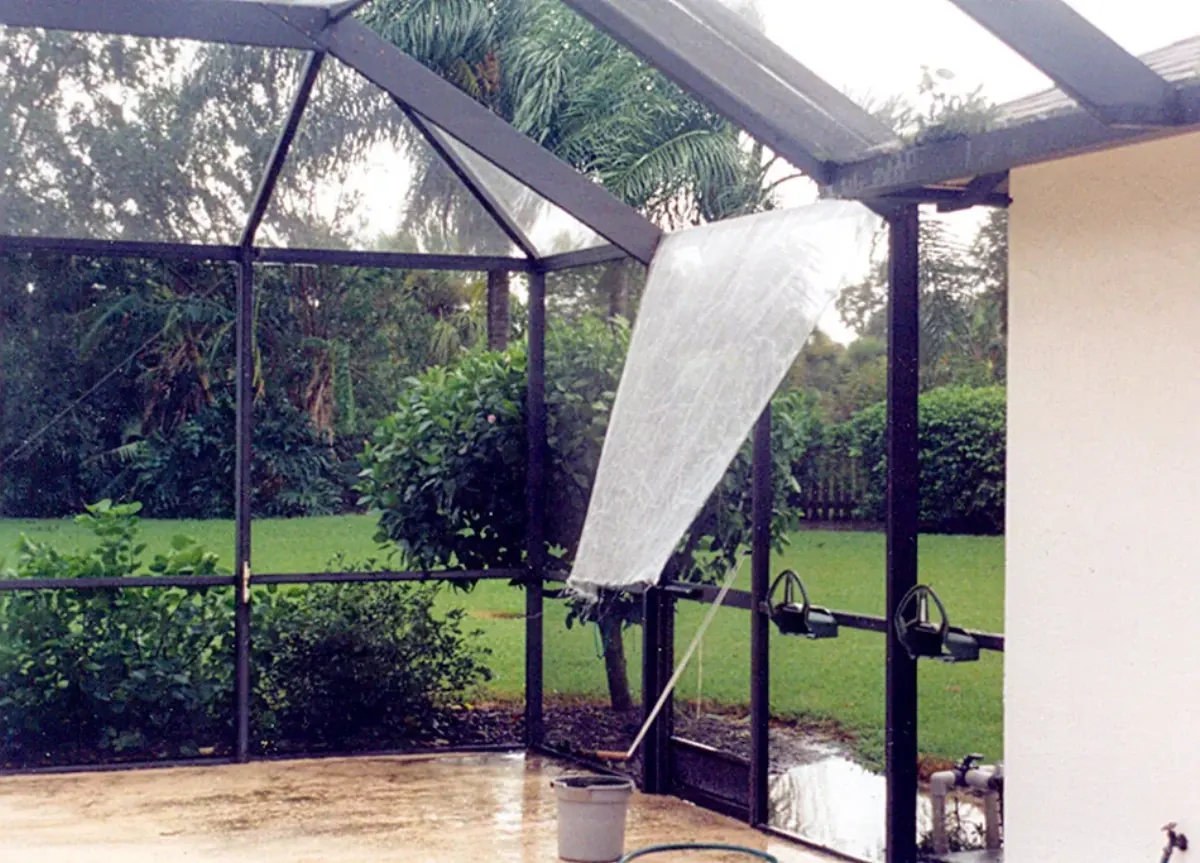
Lido Key and St. Armands flooded in Helene, and St. Armands again in Idalia, while inland neighborhoods mostly faced wind. Surge rarely folds a frame, but it can wash out the ground at footings, leave salt and sand packed into screen channels and corrode fasteners from the bottom up. Wind does the opposite: it racks the frame, rips roof panels and pulls screws at the house connection. A cage on the keys that came through Helene should have its base checked even if it looks straight.
After a storm, document before anything is moved
- Photograph every bent or broken member, torn panel and damaged door from several angles
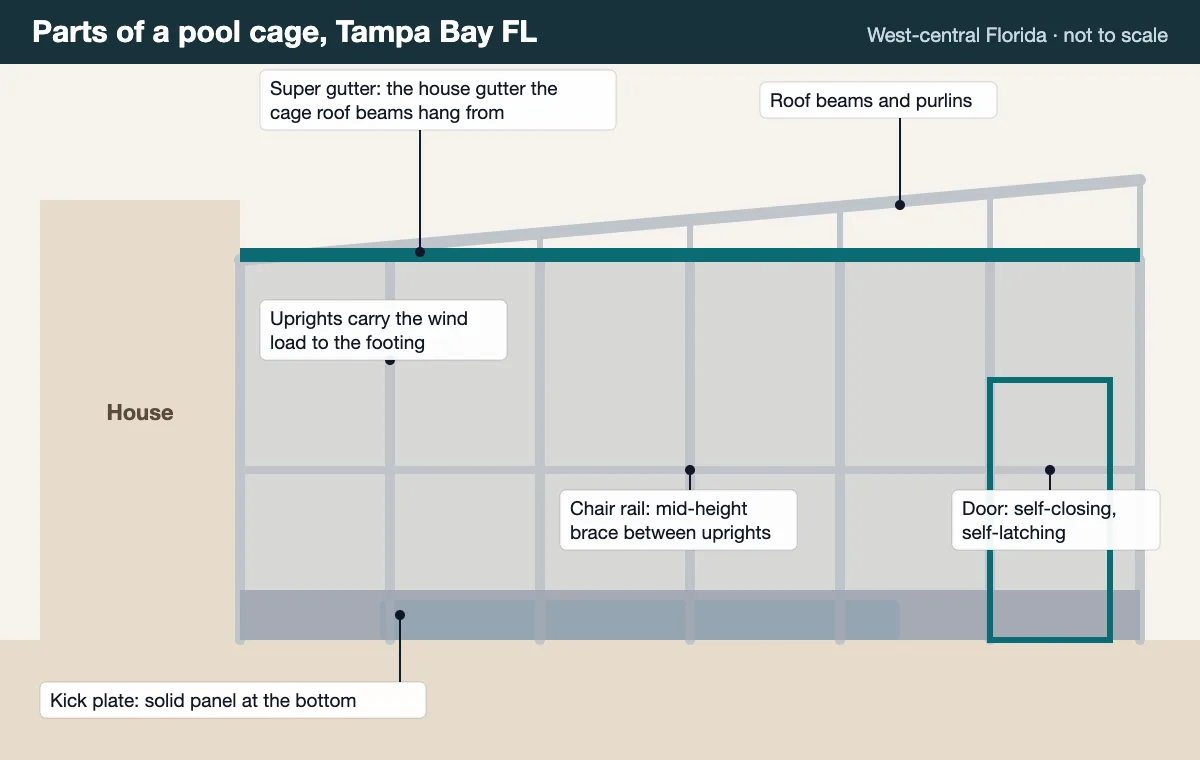
- Note whether the cage connects to the house at a super gutter, and whether that connection pulled loose
- Check doors: a cage that serves as the pool barrier must still self-close and latch
- Look for salt crust or sand in channels and soft ground at footings on flooded lots
- Keep receipts for any emergency work, such as removing a hanging section
The hurricane damage repair page covers repair versus rebuild, and pool cage replacement covers starting over.
Permit fees after a storm
After Milton, Sarasota County temporarily suspended permit fees for storm repairs, and it listed pool cage repair among them. That matters because storm repairs to a cage are structural and need a permit even when a rescreen alone might not. Fee relief is declared storm by storm, so after the next one, check the county's current notice instead of assuming the 2024 suspension still applies. City addresses should check with the City of Sarasota Building Division, which did not publish a matching notice in the sources checked.
Cutting screens before a hurricane
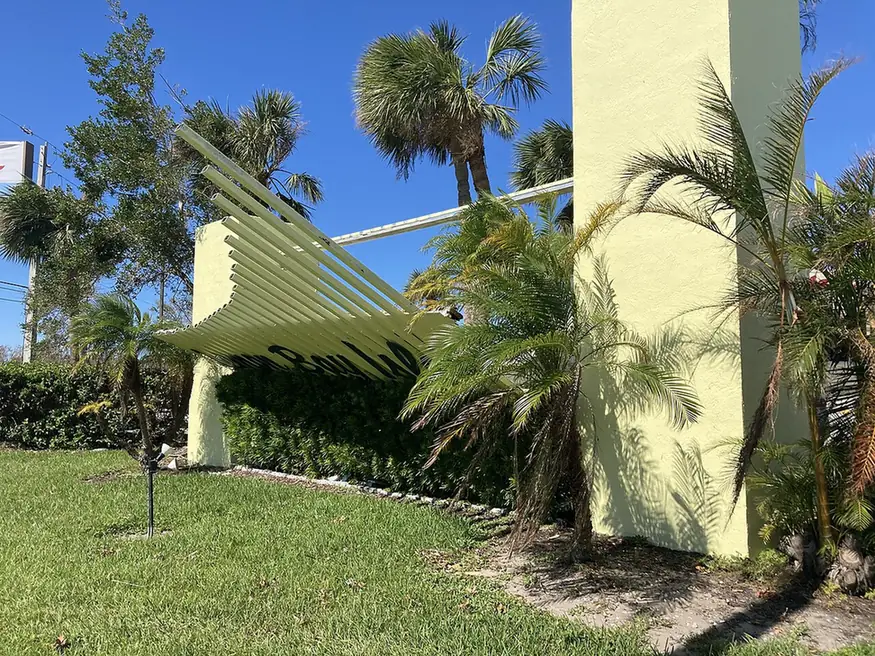
Cutting screens is part of the design only on cages engineered for it. Florida's Rule 61G20-1.002, carried into Building Code Section 2002.7, allows an alternative design where the frame's loads are based on some screen panels being removed, retracted or cut. Those cages need signed and sealed site-specific engineering, permanent labels on the members next to each panel to be cut, and panels that can be cut without ladders or scaffolding. The rule says marked screen "shall be completely cut when wind speeds are forecast to exceed 75 mph," and the contractor supplies one-time replacement screen.
A standard cage is designed with all its screen in place. A Florida structural engineering firm that analyzed the question notes that half-cut, flapping screen still transfers stress to the frame, and it is blunt that no one should risk their life cutting screens when they should be evacuating or sheltering. If your cage serves as the pool barrier, the rule also says the barrier's minimum height must remain after panels are cut.
Screens for salt air and coastal bugs
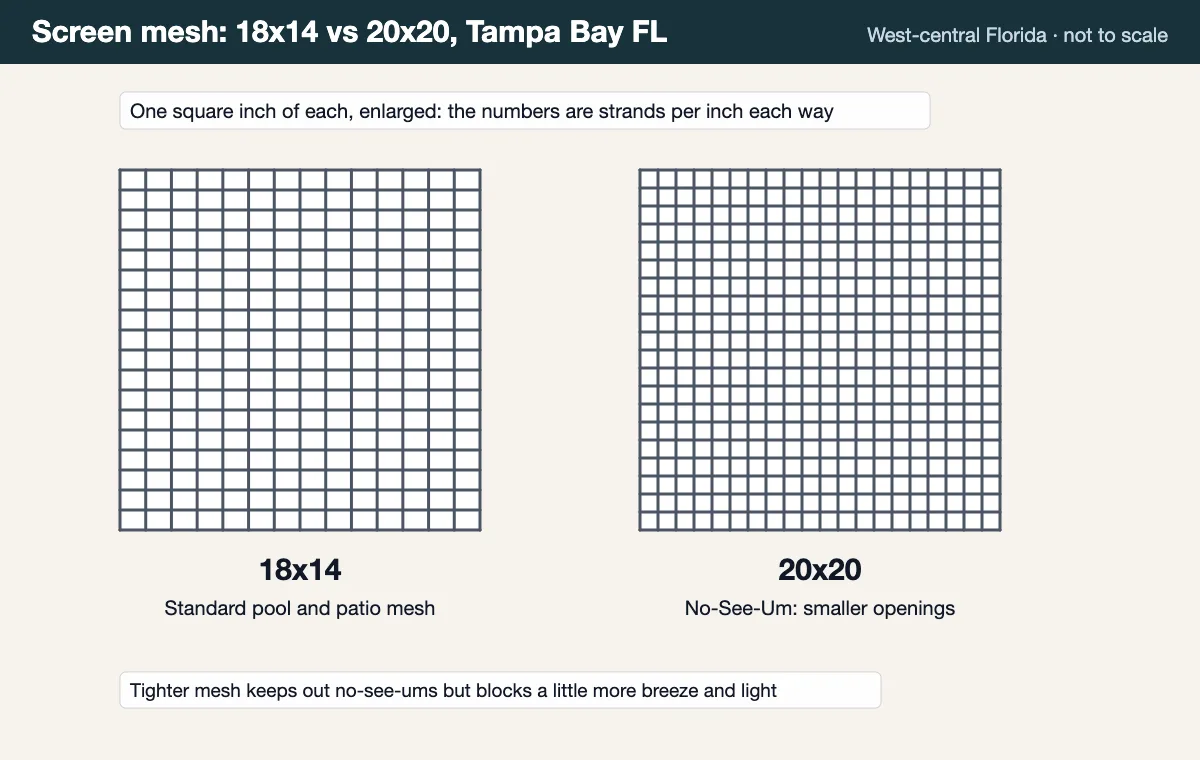
Near the bay and the Gulf, 20x20 No-See-Um mesh is the upgrade that earns its price. Phifer designs its 20x20 fiberglass to keep out no-see-ums, gnats and sand flies that live in marshy or coastal areas, which fits homes on the keys and along the bay. Elsewhere, standard 18x14 fiberglass is the default.
| Screen | What it is | Good Sarasota use |
|---|---|---|
| 18x14 fiberglass | Phifer's traditional pool and patio mesh | Inland cages, most roofs |
| 20x20 No-See-Um | Tight fiberglass weave for gnats and sand flies | Keys, bayfront and canal lots |
| TuffScreen | Heavy-duty vinyl-coated polyester | Doors and high-traffic panels |
| PetScreen | Tear and puncture resistant | Lower panels where pets push |
| Glas-Shield | Vinyl-laminated 18x14 for chair-rail-down and privacy walls; not roofs | Panels facing a neighbor or a sandy yard |
| Solar screen | Shade-oriented mesh; about $2,700 to $4,500 for a full cage in Florida | West-facing cages in afternoon sun |
Swipe the table sideways to see every column →
Product facts from phifer.com; solar screen price from a Florida contractor guide (Dec 2025). Fetched 2026-10-13.
Bugs drive most of the demand. UF/IFAS Extension in Sarasota County puts the local rainy season at June 1 through September 30, says mosquito numbers run much higher then, and advises repairing or replacing ripped screens. The screen types guide compares each mesh in detail.
Salt air, fasteners and older frames
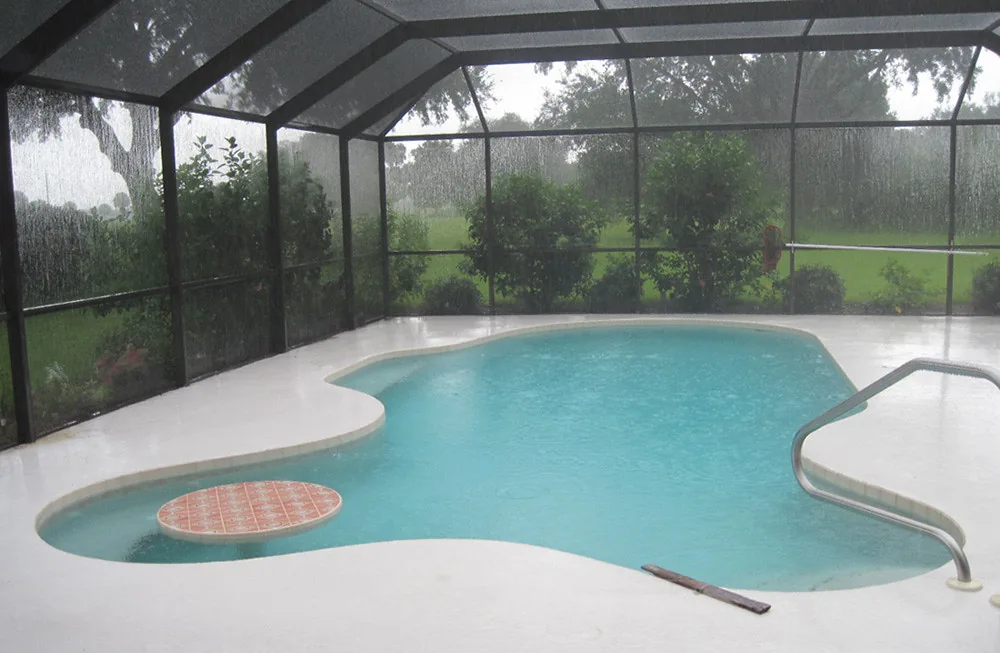
On the keys and along the bay, check fasteners every year, because salt corrodes them faster than anywhere inland. A University of Florida report to the Florida Building Commission found fastener corrosion more serious in coastal environments because of chloride, and saw the coating on stainless masonry screws, the kind commonly used for screen enclosures, peel during testing. That can set up unlike-metal reactions with the aluminum around it.
- White powder or pitting on the aluminum around screw heads
- Rust streaks running down from fasteners
- Screws you can turn by hand or that are missing from kick plates
- Paint flaking at the base of uprights where water sits
- A frame that shifts or creaks when you push an upright
A Tampa Bay contractor guide prices a full fastener refresh at $800 to $2,400 without rescreening and $1,000 to $3,400 when it is done with a rescreen, which is the usual time to do it. A chalky frame can be repainted at about $1.50 to $2.50 per square foot; see pool cage painting.
How Sarasota cages are engineered
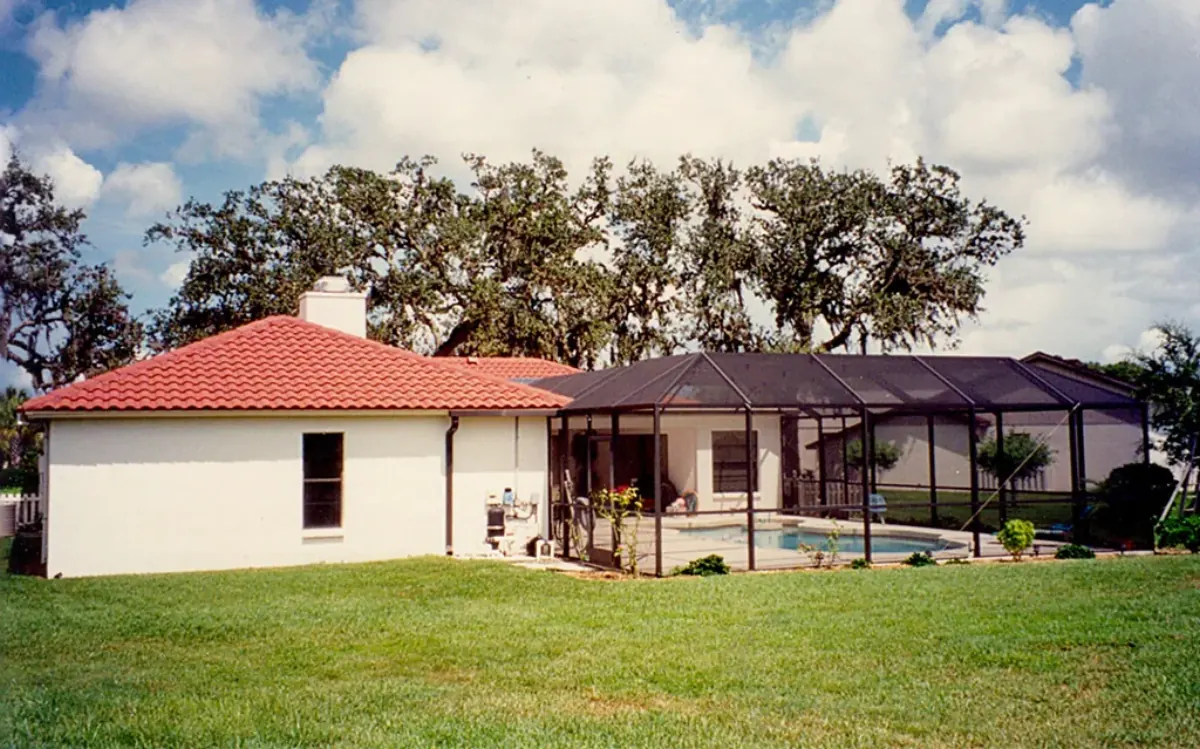
A new cage is designed to the Florida Building Code, Section 2002, for a wind of about 149 mph at the city center. That figure comes from the ASCE 7-22 map for Risk Category II, which represents roughly a 700-year wind. The Florida Building Commission notes that peninsula design speeds have not effectively changed since the 2010 code, and that local jurisdictions often modify the maps, so the building department has the last word for your site.
- Extruded aluminum members must be at least 0.040 inch thick.
- The frame is designed for wind from two directions using the code's Table 2002.4 pressures.
- Each primary member must also carry a 300 pound load along any 1 foot.
- The AAF Guide to Aluminum Construction in High Wind Areas is accepted as conforming engineering, the kind of engineered specification the city's plan requirements accept in place of site-specific sealed plans.
- Removable vinyl, glass or acrylic panels must carry a decal saying they must be removed above 75 mph.
Work on screen and pool enclosures falls under Florida's Specialty Structure Contractor license, whose scope covers screened porches, screened enclosures and pool enclosures. Asking for the license number is a reasonable first step. New builds are covered on pool enclosure installation.
Cages on Sarasota's architecture
Sarasota is home to the Sarasota School of Architecture, a mid-century modern style that mixed Bauhaus with Frank Lloyd Wright's organic architecture, and a cage on one of those houses should respect its lines. On a house like that, the cage's roof shape, height and frame color are design decisions as much as construction ones, and the city's placement rule already keeps cages off the street side. The pool enclosure styles guide compares roof shapes, and one Central Florida company prices gable roofs 10 to 20 percent above a comparable mansard.
Insurance and your pool cage
Assume your pool cage is not covered for hurricane damage until your policy says otherwise. Citizens' HO-3 coverage worksheet says screen pool cages and aluminum-framed screened enclosures built open to the weather are not covered, and its hurricane flyer lists open enclosures as typically not covered. Florida's Department of Financial Services describes a Screened Enclosure and Carport Endorsement that covers screened enclosures damaged as a result of a hurricane; ask whether your insurer offers it.
The deductible is the other half. Under Florida law, insurers must offer hurricane deductibles of $500 or 2, 5 or 10 percent of the dwelling limit, and the deductible applies once per calendar year across all hurricanes. With Ian, Idalia, Helene and Milton in three seasons, that annual rule is not academic here. The pool cage insurance guide works through examples.
Rescreen, repair or replace?
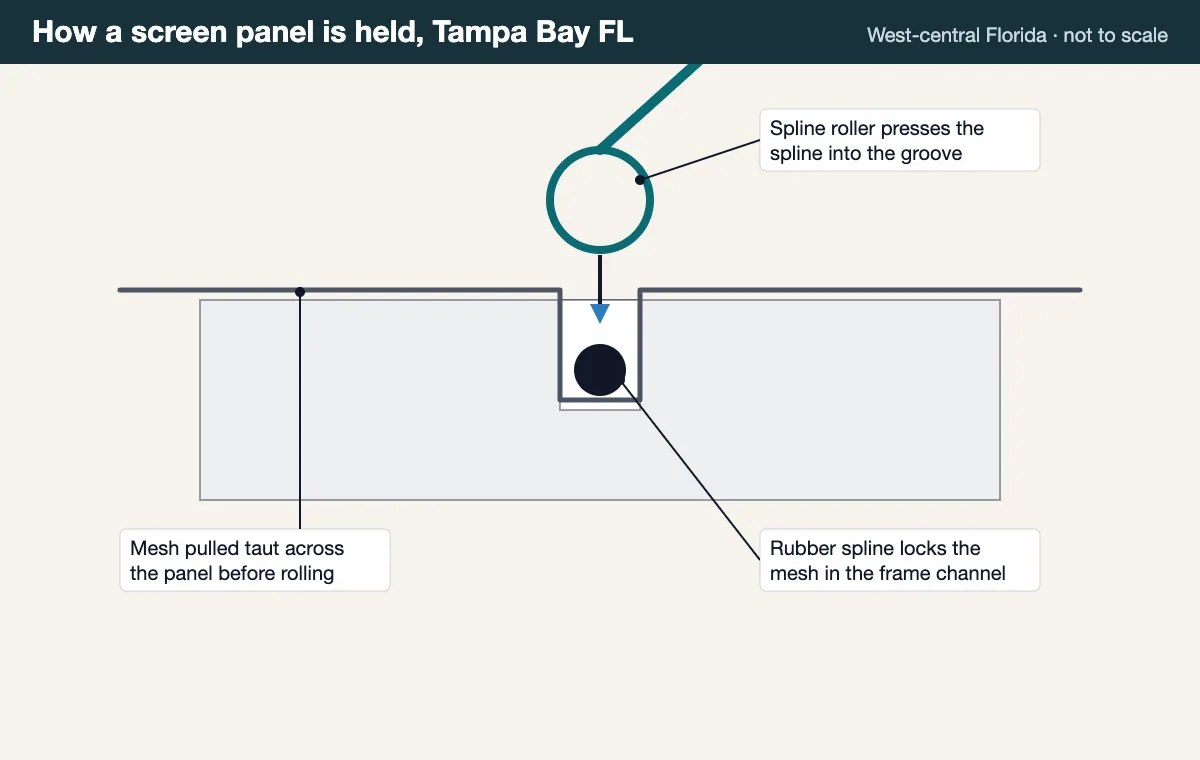
Rescreen when the frame is straight and tight, repair when a few panels or a door are the problem, and replace when members are bent or corroded through. Florida contractors put standard fiberglass screen at about 5 to 10 years in this sun and a well-kept frame at 20 to 30 years or more.
| What you see | Likely job | Where to start |
|---|---|---|
| Faded, brittle or sagging screen on a sound frame | Full rescreen | Pool cage rescreening |
| A few torn or popped panels | Panel repair | Pool screen repair |
| Door drags, will not latch or close | Door and hardware | Pool cage door replacement |
| Chalky paint, loose screws, no bends | Paint and fastener refresh | Pool cage painting |
| Leaking or sagging gutter at the house | Gutter work | Pool cage gutter repair |
| Bent beams, racked frame, storm damage | Structural repair or rebuild | Hurricane damage repair |
Swipe the table sideways to see every column →
General guidance; a contractor's inspection of the frame decides the actual scope.
Start with pool cage rescreening, pool screen repair, pool cage door replacement or pool cage gutter repair, depending on what you see.
The cage as your pool barrier
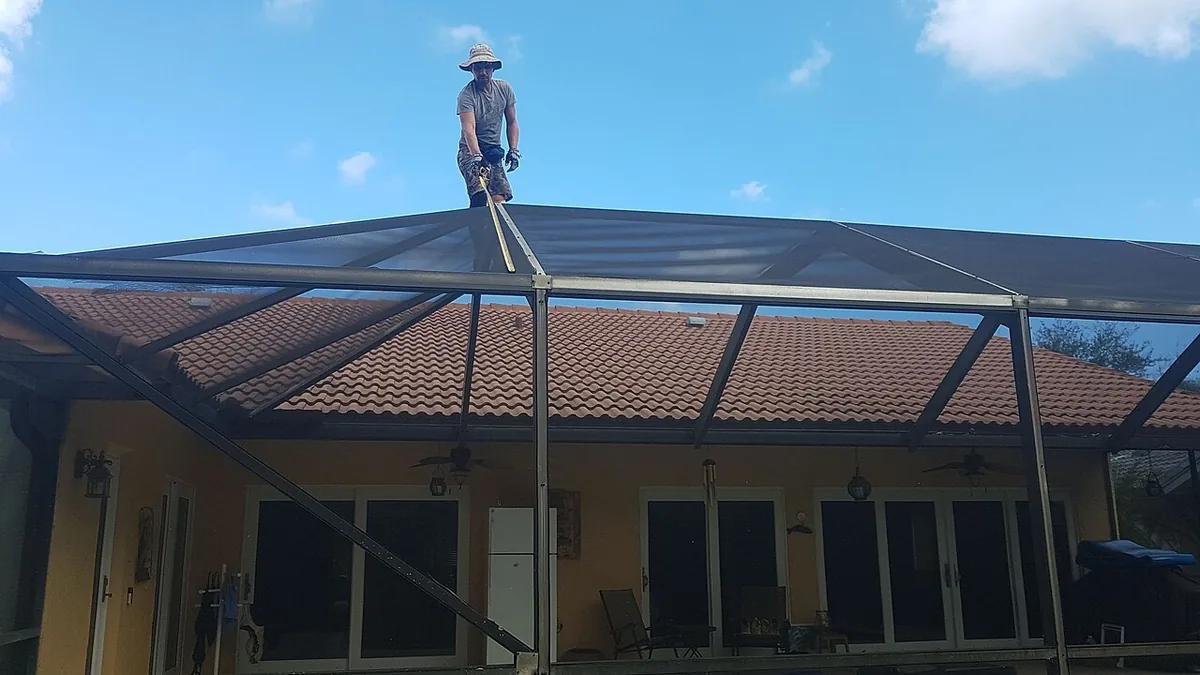
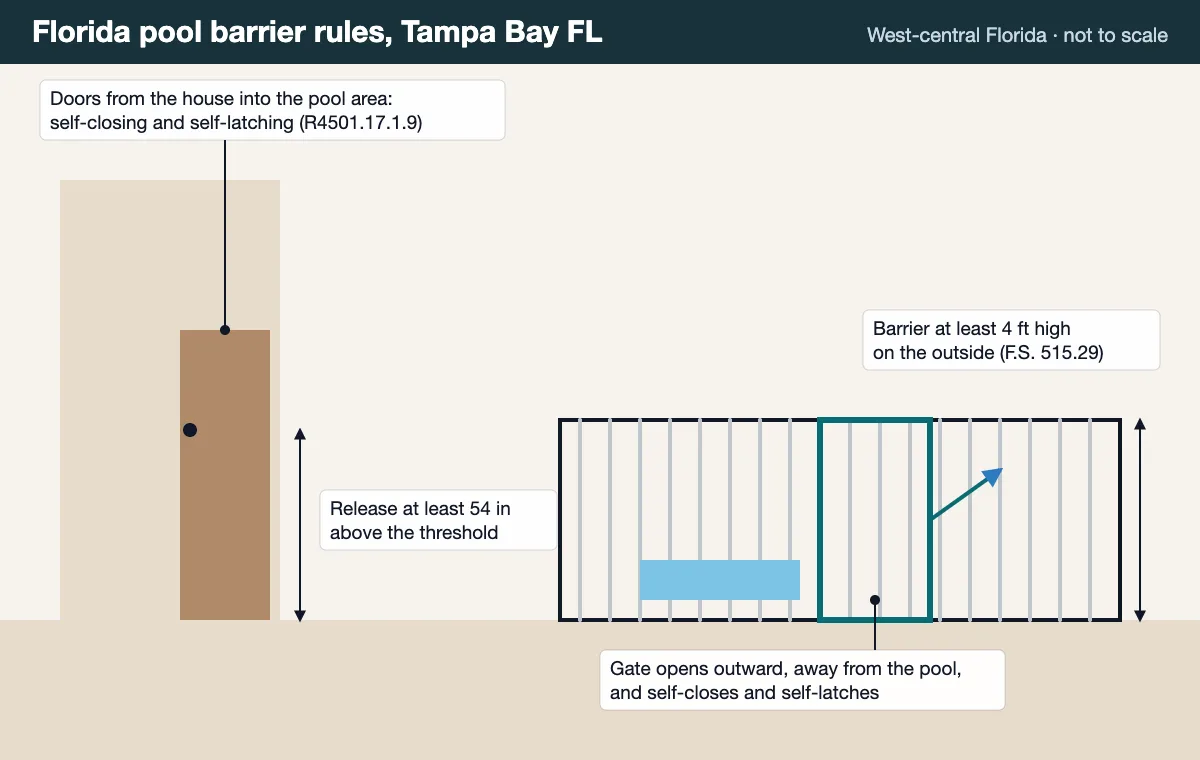
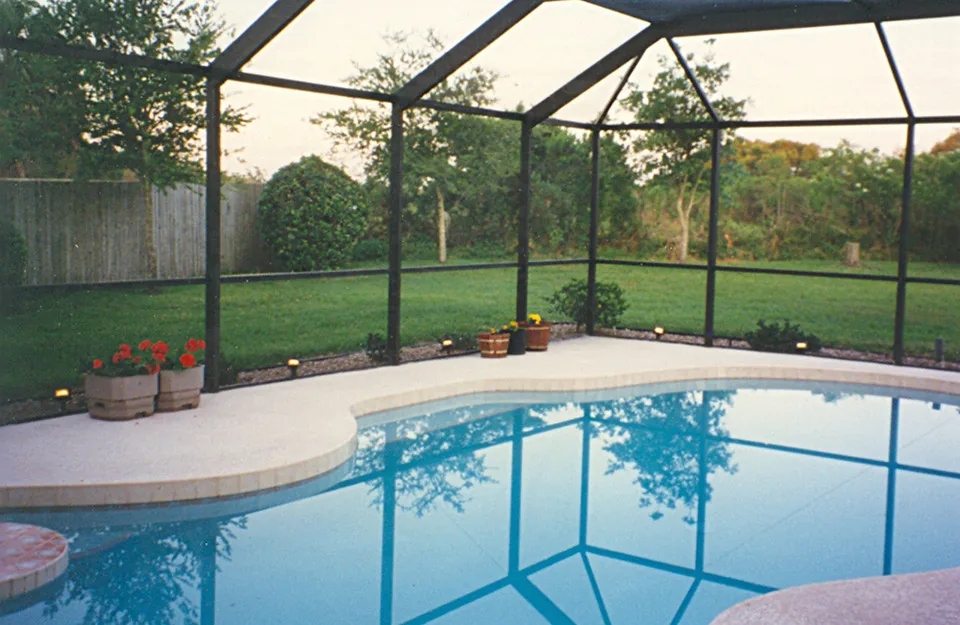
If your screen enclosure is the barrier around the pool, its doors are a safety item, not a convenience. The Florida Residential Code lets a standard screen enclosure serve as all or part of the required pool barrier. State law sets the barrier at least 4 feet high on the outside, with no gaps a young child could squeeze through, and gates that open outward, self-close and self-latch with the release on the pool side. A worn closer or a bent latch defeats all of that.
Sarasota and nearby
Sarasota sits on US 41, the Tamiami Trail, with I-75 to the east. Neighbors with their own pages include Lakewood Ranch, Venice and Bradenton. For the permit rules of every county in the region, see the Tampa Bay pool enclosure permit guide. Every town is on the service area page, or request a free quote.