Screen enclosure work in Lakewood Ranch, FL runs through two filters before it reaches a building department: your village's architectural rules and the county your lot sits in. Lakewood Ranch is an unincorporated planned community of 34,877 people (2020 census) spread across southeastern Manatee County and northeastern Sarasota County, bounded by State Road 64 to the north, Fruitville Road to the south and I-75 to the west. Its first neighborhood, Summerfield, was finished in 1995, which means the oldest cages here are now about 30 years old.
That age matters. Frames from the late 1990s and early 2000s are reaching the end of their expected life just as newer villages like Star Farms, Waterside and Del Webb Catalina fill with fresh builds. This page covers the screen enclosure Lakewood Ranch FL owners need to plan around in both cases: the published village rules, prices, permits, storm history and screen choices.
Lakewood Ranch village rules for pool cages
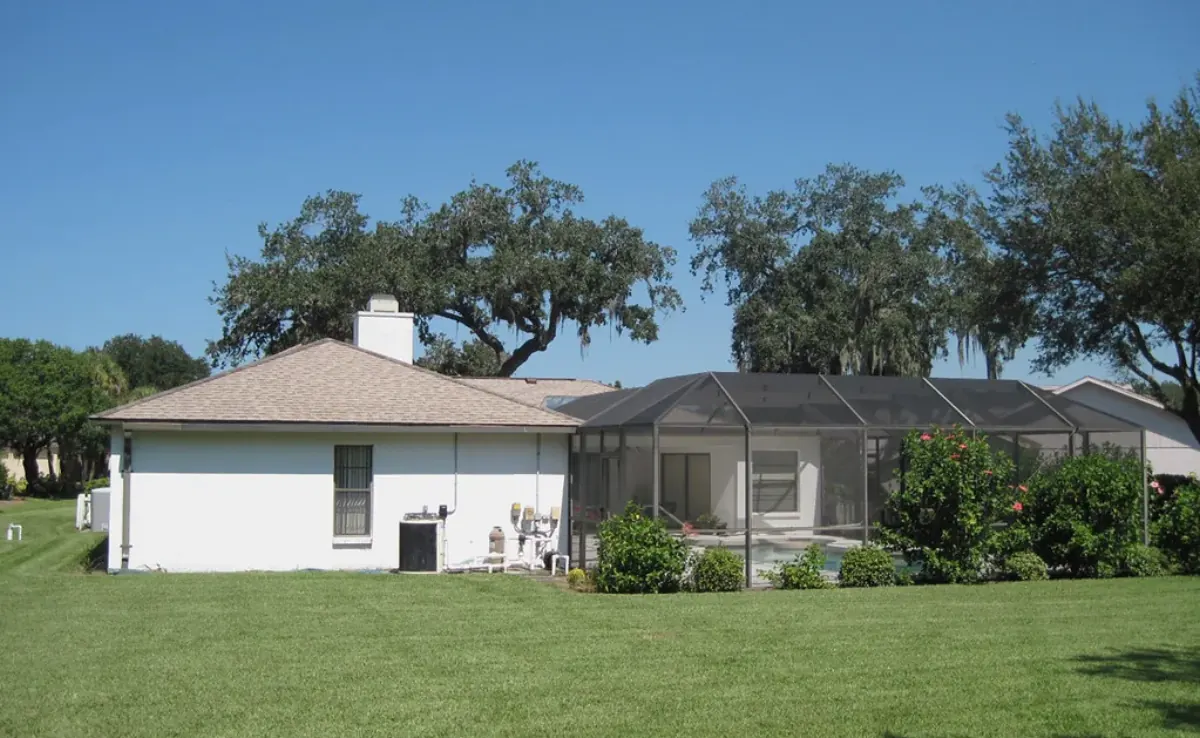
In Country Club and Edgewater villages, a cage must be charcoal-screened, square or rectangular, below the roofline, hidden from the street, and mansard-roofed once its top reaches 100 square feet. These rules come from the Country Club/Edgewater Village Association (CEVA) Homeowners Manual, March 2022. Its Modifications Committees also serve as the Architectural Review Committees.
| Rule | What the manual says | What it means for your job |
|---|---|---|
| Like-for-like replacement | No approval needed if the replacement cage is exactly like the original | A same-color, same-shape rescreen or rebuild can go ahead without a form |
| New or redesigned cage | Modification Request Form, approved by CEVA or its designee | Get approval before ordering engineering or materials |
| Frame color, Country Club Village | Bronze aluminum (Muirfield and Spyglass follow neighborhood standards) | White frames are out unless your neighborhood standard allows them |
| Frame color, Edgewater Village | White or bronze | Either finish is allowed |
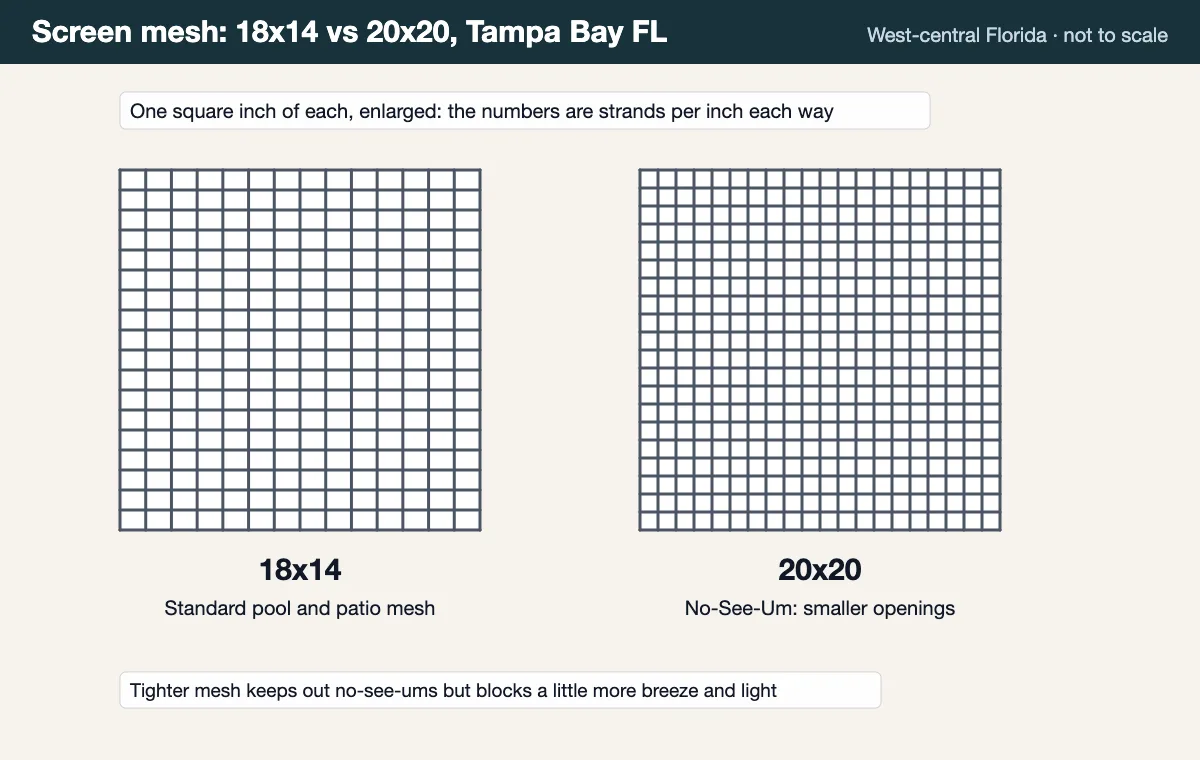
| Screen | Charcoal, 18x14 or 20x20 mesh, fiberglass or fiberglass-coated PVC | Standard charcoal 18x14 and No-See-Um 20x20 both comply |
| Shape | Square or rectangular | Curved or freeform footprints are not allowed |
| Roof | Mansard-type once the top is 100 sq ft or more; no curved roofs | Curved and dome roofs are out; large cages get a mansard |
| Height | Roof may not exceed the height of the house | Two-story screen roofs over a one-story home do not fit |
| Street view | No part may be seen from the street directly in front of the home | Placement and height are checked against the front elevation |
| Repainting | Repaint to white or an approved bronze needs a Modification Request Form | A color refresh is not like-for-like; file first |
Swipe the table sideways to see every column →
From the CEVA Homeowners Manual (March 2022), published online, fetched 2026-10-13. These rules cover Country Club and Edgewater villages only; other villages have their own documents. Check with your association before work starts.
Lakewood Ranch is governed by the Lakewood Ranch Stewardship District and five community development districts, with an Inter-District Authority running Town Hall, and each village or sub-association can set its own exterior standards. The CEVA rules are the most detailed published example and a good guide to what review committees across the Ranch look at: color, shape, roof style, height and what the street sees.
What screen enclosures cost in Lakewood Ranch
Expect $1,500 to $4,500 to rescreen a typical cage and $10,000 to $30,000 or more for a new engineered pool enclosure. Village rules tilt the numbers slightly: charcoal screen is standard pricing, but a required mansard roof on a large cage carries more screen area and more panels than a flat lanai roof.
| Job | Published range | Source and date |
|---|---|---|
| Full rescreen, Florida | $1,500 to $4,500+ | Florida contractor guides, Dec 2025 and Mar 2026 |
| Large or two-story mansard rescreen, 40 to 60+ panels | $2,800 to $4,500 | Central Florida screen company, 2026 |
| Large two-story cage in 20x20 No-See-Um | $4,500 to $7,500+ | Tampa Bay contractor guide, Mar 2026 |
| Upper panel on a mansard cage, per panel | $60 to $120 | Central Florida screen company, 2026 |
| New pool enclosure, typical project | $10,000 to $30,000+ | Tampa Bay screen contractor price page, 2026 |
| Mansard vs gable, covered area | Mansard $6 to $10 per sq ft; gable $7 to $12 (10 to 20 percent more) | Central Florida screen company, 2026 |
| Full cage replacement | $12,000 to $25,000+ | Tampa Bay contractor guide, Jan 2026 |
| Frame repaint | $1.50 to $2.50 per sq ft | Tampa Bay contractor guide, Jan 2026 |
Swipe the table sideways to see every column →
Published contractor price guides fetched 2026-10-13. The mansard and gable figures are one Central Florida company's numbers for covered area and run lower than Tampa Bay totals; use them for the price difference between roof styles, not as a full quote.
Why the mansard rule matters for price
A mansard roof slopes down on all sides to a flat top, so it adds a ring of angled panels between the walls and the roof. Those upper panels are priced higher than ground-level panels because they need ladders and more time, which is why a large mansard cage sits at the top of most rescreen ranges. The upside is that mansard is also the cheaper roof to build new: one Central Florida company prices gable cages 10 to 20 percent above a comparable mansard.
Screen enclosure work in Lakewood Ranch
Most cage work in Lakewood Ranch falls into five jobs: rescreening, panel repair, frame restoration, door work and full replacement of an older cage. Each has its own page with prices and details.
- Pool cage rescreening: new charcoal mesh in every panel, the most common job on 1990s and 2000s cages.
- Pool screen repair: a few torn or popped panels after a storm or a pet.
- Lanai screen repair: screened lanais under the house roof, with or without a pool.
- Pool cage painting: restoring a chalky bronze finish; remember that a repaint needs a form in CEVA villages.
- Pool cage replacement: tearing down a corroded or storm-bent frame and building a new one to current code.
Homes in the newer villages often need a first cage on a new pool, which is a pool enclosure installation job with engineering, a permit and, in most villages, design approval first.
Screen choices that pass village review
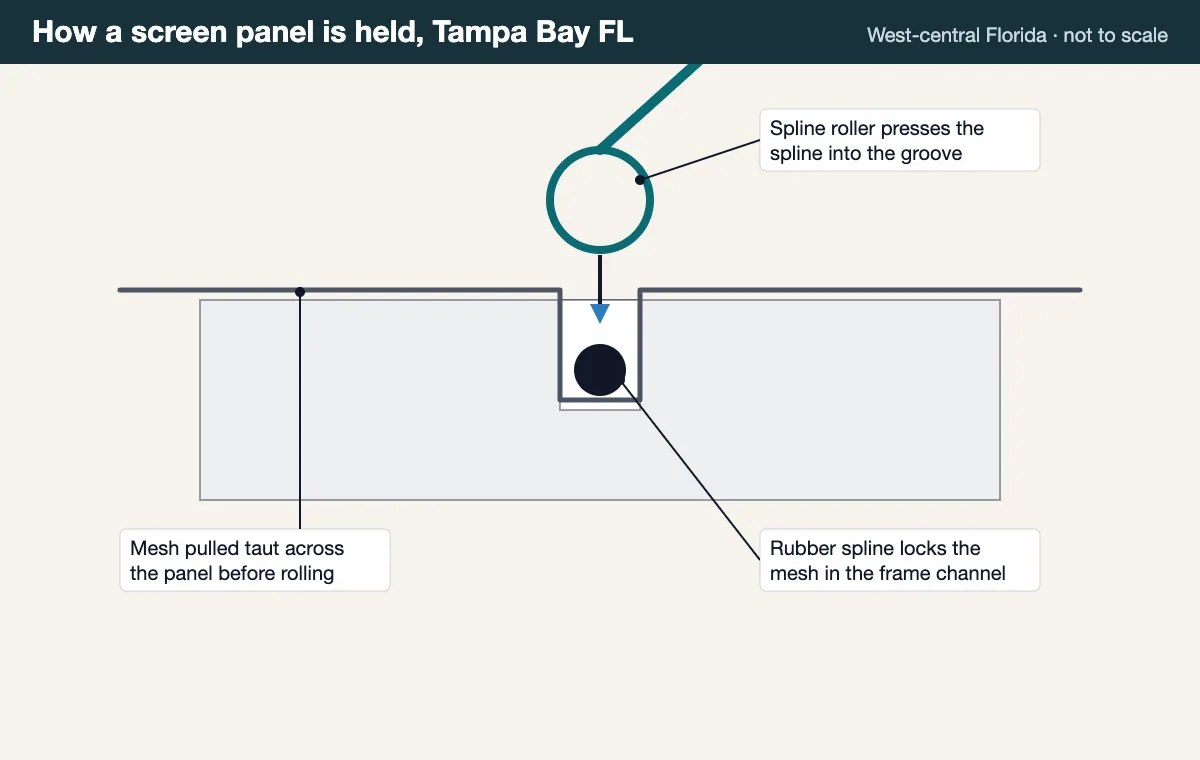
Charcoal 18x14 fiberglass is the safe default; charcoal 20x20 No-See-Um is the upgrade most worth considering near the Ranch's lakes and the Braden River. Phifer describes its 20x20 mesh as designed to keep out no-see-ums, gnats and sand flies found in marshy or coastal areas. Both meshes appear by name in the CEVA screen rule.
Bugs are the reason most of these cages exist. UF/IFAS Extension in Sarasota County notes that the rainy season runs June 1 to September 30 and that mosquito populations tend to be much higher then, and it recommends repairing or replacing ripped screens. Lovebugs swarm across Florida for a few weeks every April to May and August to September, and UF/IFAS lists screens over decks and pools as one way to keep them out.
| Screen | What it is | Fit with CEVA rules |
|---|---|---|
| 18x14 fiberglass, charcoal | Phifer's traditional pool and patio mesh | Named in the rule |
| 20x20 No-See-Um, charcoal | Tighter fiberglass weave for gnats and sand flies | Named in the rule |
| PetScreen | Tear and puncture resistant mesh for dogs and cats | Not named; ask before using |
| TuffScreen | Heavy-duty vinyl-coated polyester | Check it is fiberglass-coated PVC or get approval |
| Glas-Shield | Vinyl-laminated 18x14 for lower panels and privacy walls, not roofs | A visible change; ask before using |
Swipe the table sideways to see every column →
Product descriptions from phifer.com; rule fit from the CEVA Homeowners Manual (March 2022). Fetched 2026-10-13.
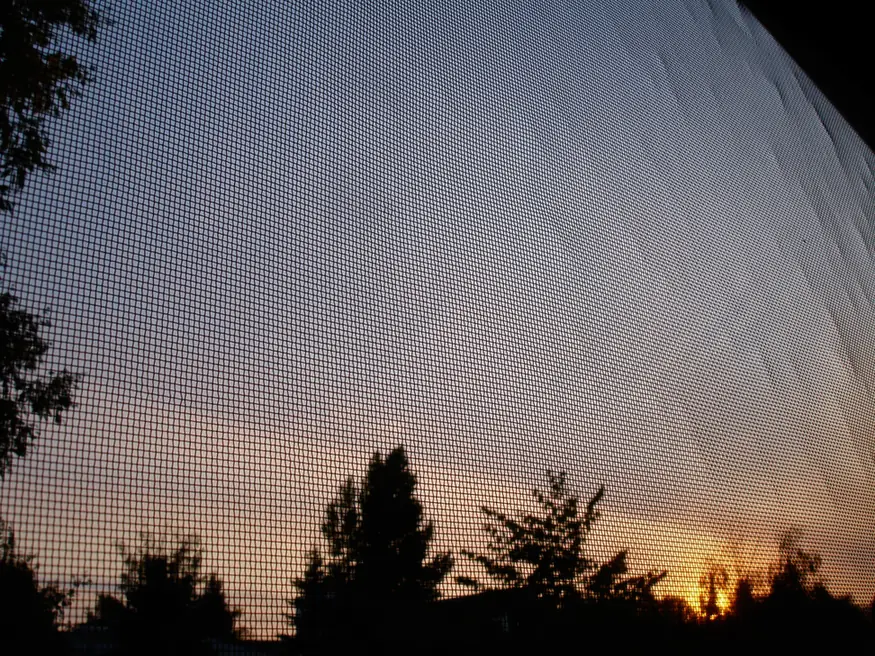
The pool cage screen types guide compares every mesh in more depth.
What Milton and Debby did in Lakewood Ranch
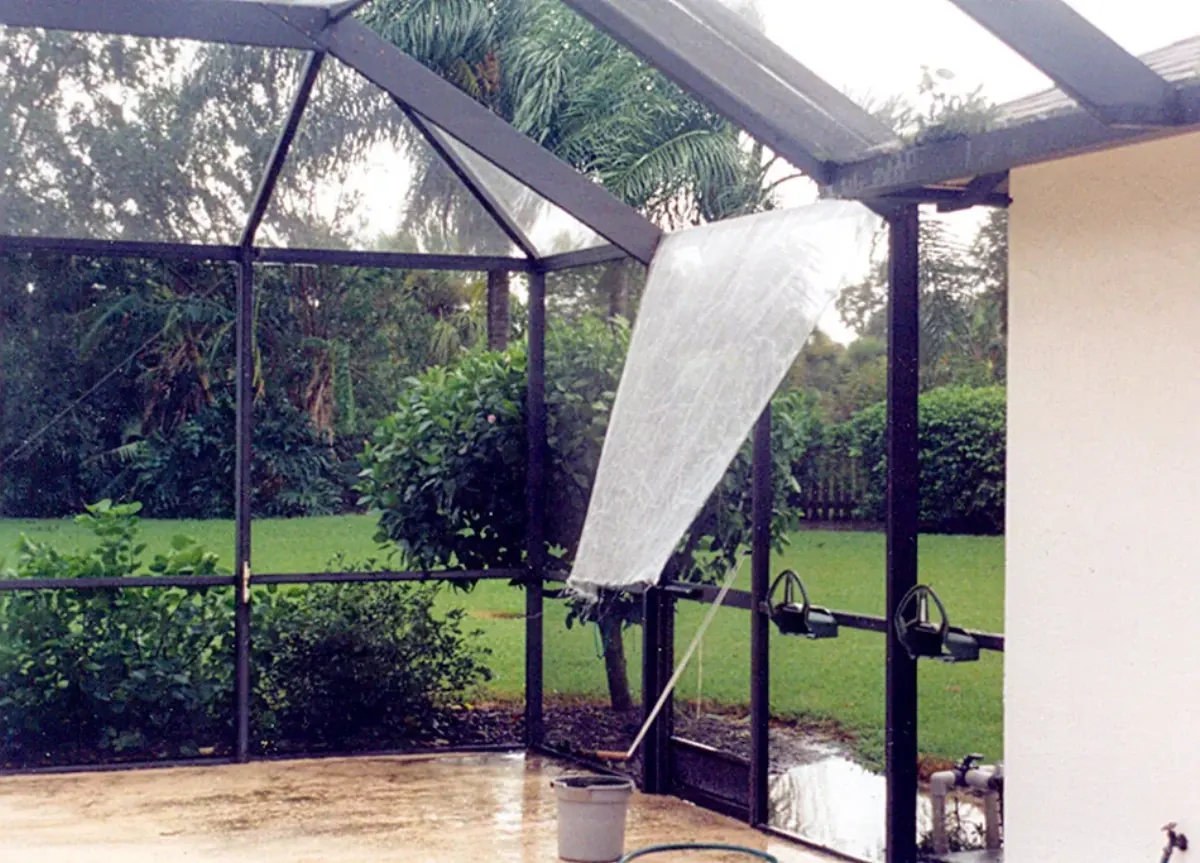
Milton brought winds measured at 100 mph or more to the Bradenton and Lakewood Ranch areas in October 2024, and East County pool cages came apart. The Observer's storm coverage described a Mill Creek family whose son heard their pool cage creaking before it blew apart, just after he got inside. In Greenbrook, a neighbor's house had roof and lanai damage. At Waterside Place a pavilion lost two columns, and a traffic signal on 44th Avenue was blown into Central Park.
Two months earlier, Debby showed the flood side of the risk. The Braden River at River Club Boulevard took 11.57 inches of rain in 24 hours, which the Observer's report on county flooding noted exceeds a 100-year storm design, and the river swelled over its banks into homes on Quonset Road. Floodwater around a cage can scour slab edges and footings and leave silt in the screen channels even when the frame stays upright. If the deck slab under the cage cracked or settled after that kind of water, look at pool deck repair before new screen goes up, since the cage posts sit on that edge.
Check these after a storm
- Uprights and beams for kinks, bows or twisting
- The connection to the house fascia or super gutter for pulled or sheared screws
- Roof panels torn by debris, and panels popped out of the spline
- Doors that no longer self-close and latch (the cage may be your pool barrier)
- Silt lines and soft ground at the base after flooding near the Braden River
Photograph everything before cleanup. The hurricane damage repair page covers the claim side, and the guide to whether pool cages are hurricane proof explains why even engineered frames fail.
Permits on the Manatee and Sarasota sides
The county line runs through Lakewood Ranch, so the same cage can face two different permit offices. Lakewood Ranch addresses use ZIP codes 34202, 34211, 34212 and 34240, but a ZIP code does not tell you the county. Your property appraiser's parcel record does.
| Item | Manatee County side | Sarasota County side |
|---|---|---|
| Rescreen only | No permit, but a licensed contractor is required | Not addressed on the county's no-permit list; ask |
| New screen enclosure | Permit, plans, site plan or survey, licensed contractor | Permit required for any construction or addition |
| Aluminum structure fee | $210 (effective Apr 1, 2023) | Not published in the documents checked |
| Pool cage setback | 5 ft from side and rear lines, out of easements and swales | Check zoning for the lot |
| Flood zone | Exemptions do not apply | A permit is required for listed items in a flood zone |
| Post-Milton storm repairs | Fees waived for storm repairs through Mar 1, 2025 | Fees suspended for storm repairs including pool cage repair |
| Online portal | Accela | Accela (Online Permitting Services) |
Swipe the table sideways to see every column →
Manatee County 'What does not require a permit' (updated 6-16-26) and fee schedule; Sarasota County Building Permit Guidelines (updated August 2026); WGCU post-Milton permit report, Oct 24, 2024. Fetched 2026-10-13.
Both counties must also offer Florida's new HB 803 exemption for non-structural work under $7,500 on a written request, outside flood hazard areas. Whether a rescreen counts as non-structural is the building official's call. The Tampa Bay pool enclosure permit guide covers both counties in full.
Designing a new cage for a Lakewood Ranch home
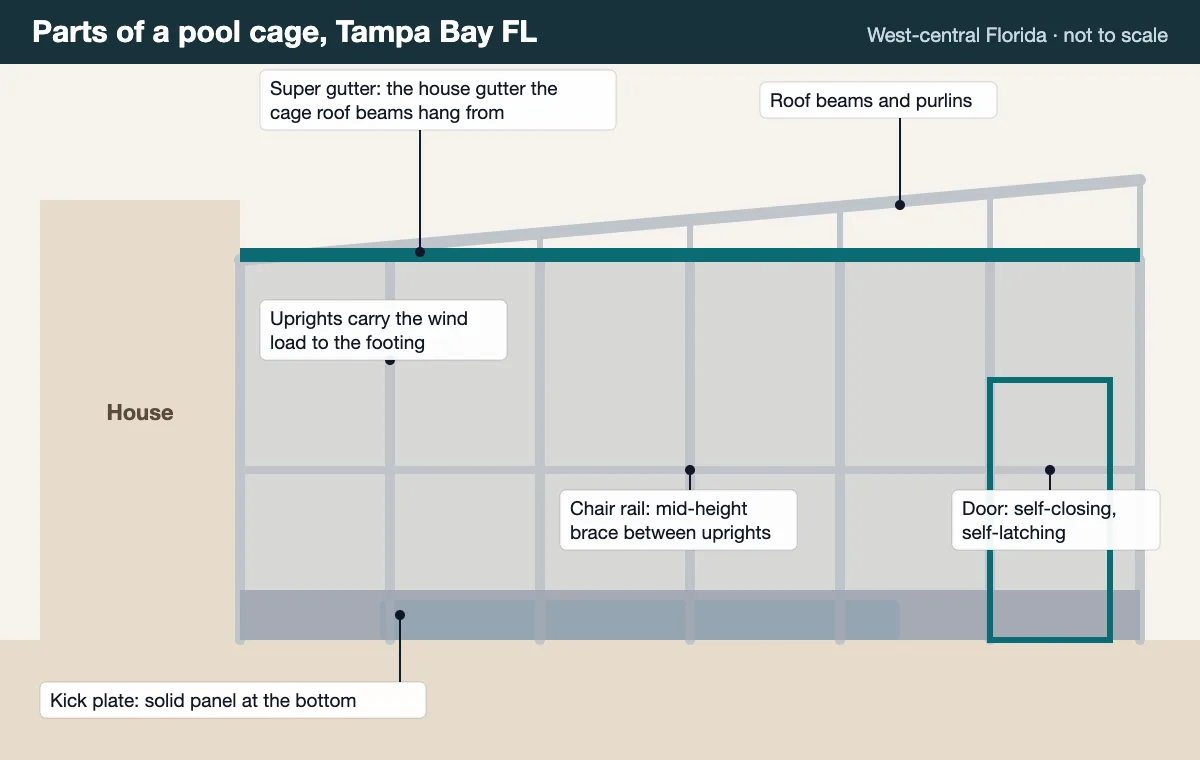
A new cage here has to satisfy three sets of rules at once: the Florida Building Code, the county zoning setback and the village's design standards. Getting all three on one drawing before anything is ordered is what keeps a project from stalling.
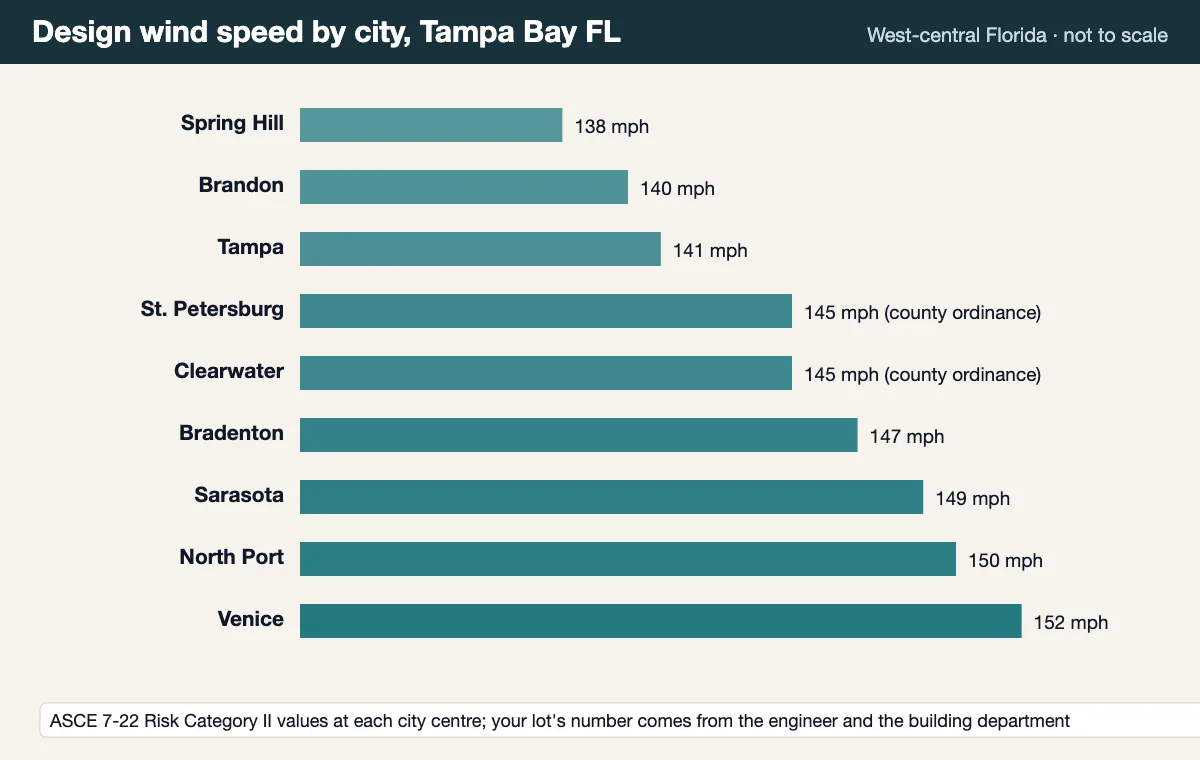
- Code: Florida Building Code Section 2002 sets a minimum 0.040 inch wall thickness for extruded aluminum members and wind design from two directions. ASCE 7-22 design wind values at nearby Bradenton and Sarasota city centers are about 147 and 149 mph; the engineer confirms the exact figure for your lot.
- Setback: on the Manatee side, pool cages sit at least 5 feet from side and rear lines and may not encroach into easements or drainage swales, which run behind many lake lots.
- Village design: in CEVA villages the cage stays square or rectangular, below the house roof, out of view from the street in front, with a mansard roof once the top reaches 100 square feet.
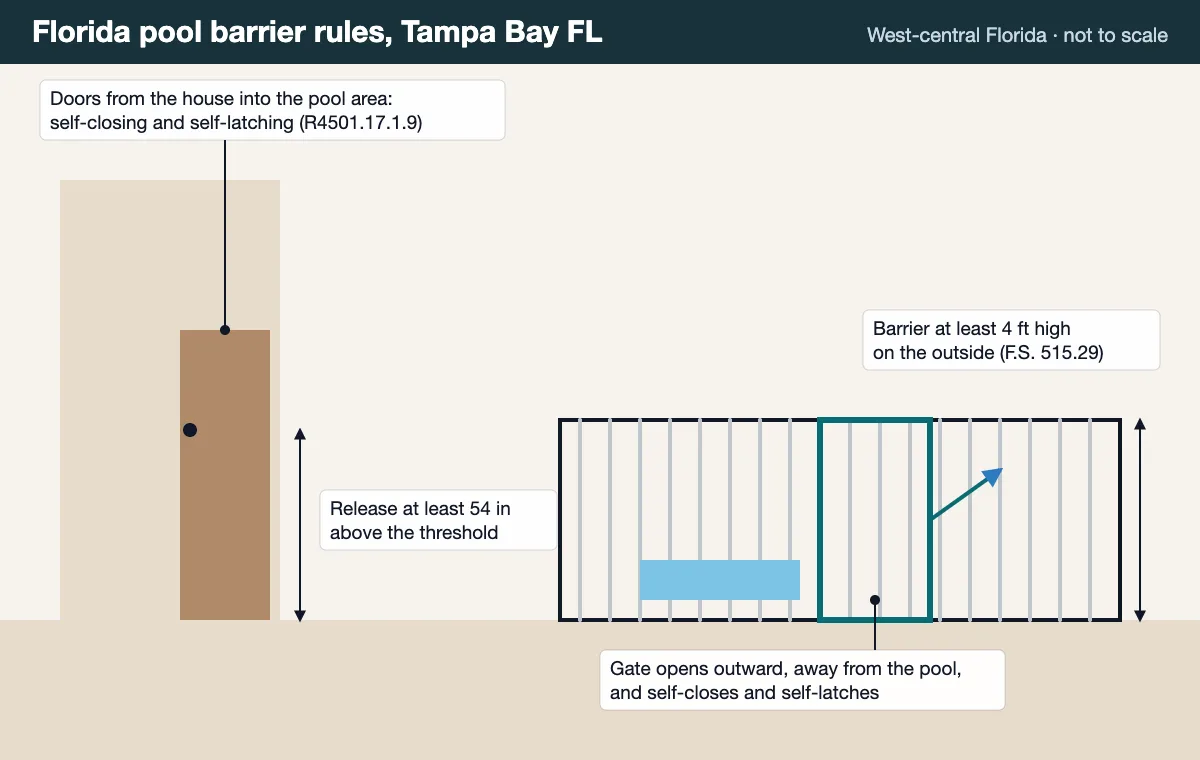
- Pool barrier: a standard screen enclosure can count as the pool barrier under the Florida Residential Code, so doors should open outward, self-close and self-latch, and the barrier must be at least 4 feet high on the outside.
- Color: bronze frames with charcoal screen satisfy Country Club Village; Edgewater allows white or bronze.
A cage that matches the house roofline and the frame color of its neighbors is also the one that sails through review. Bronze frames with charcoal mesh, kept below the roofline and out of the street view, is the look the CEVA standards are written around.
Insurance before the next storm
Check your policy now, not after a storm. Citizens' HO-3 coverage worksheet says screen pool cages and aluminum-framed screened enclosures open to the weather are not covered, and Florida insurers must offer hurricane deductibles of $500, 2, 5 or 10 percent of the dwelling limit, applied once per calendar year. On a Lakewood Ranch home, a percentage deductible can easily exceed the cost of a rescreen. The pool cage insurance guide walks through the math.
Pool cage or lanai enclosure?
A pool cage is a free-standing engineered frame with its own screen roof over the pool and deck; a lanai enclosure is screen walls under the house's existing roof. The cage carries wind on its own roof and needs full engineering. A lanai screen job leans on the house structure, costs less and, in Manatee County, needs no permit when it only screens an existing roof and slab and the kick plate stays at 12 inches or lower.
How to compare screen enclosure contractors
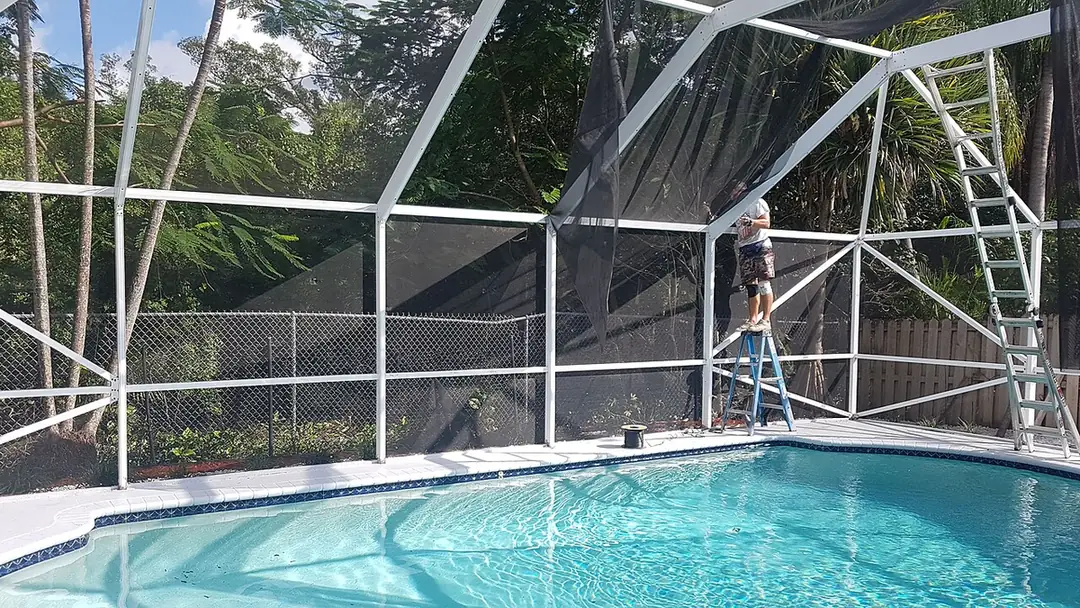
Start with the license: in Florida, screen and pool enclosures fall under the Specialty Structure Contractor category, and Manatee County requires a licensed contractor even for rescreening. Then compare quotes on the same terms.
- A state license number you can look up, in the specialty structure or a broader category
- The screen named by product and color (charcoal 18x14 or 20x20), matching your village rule
- Whether the quote covers spline, door screens, closers and kick plates or only the main panels
- Who files the Modification Request Form if your job is not like-for-like
- For new cages: signed and sealed engineering and the permit fee shown as a line item
- Whether loose or rusted fasteners are replaced as part of the job or priced separately
Keeping a Lakewood Ranch cage in shape
Rinse the screen and frame a few times a year, keep plants off the mesh, and tighten or replace loose screws before they let panels pop. Pressure washing a cage runs about $150 to $300 in Tampa Bay pricing, and a full fastener refresh $800 to $2,400. A frame repaint every 5 to 10 years keeps bronze from going chalky, but in CEVA villages a repaint to a new color needs approval first. The guide on how to clean a pool cage has the steps.
Lakewood Ranch and nearby
Nearby pages cover Bradenton, Parrish and Sarasota. See every town on the service area page, or request a free quote.