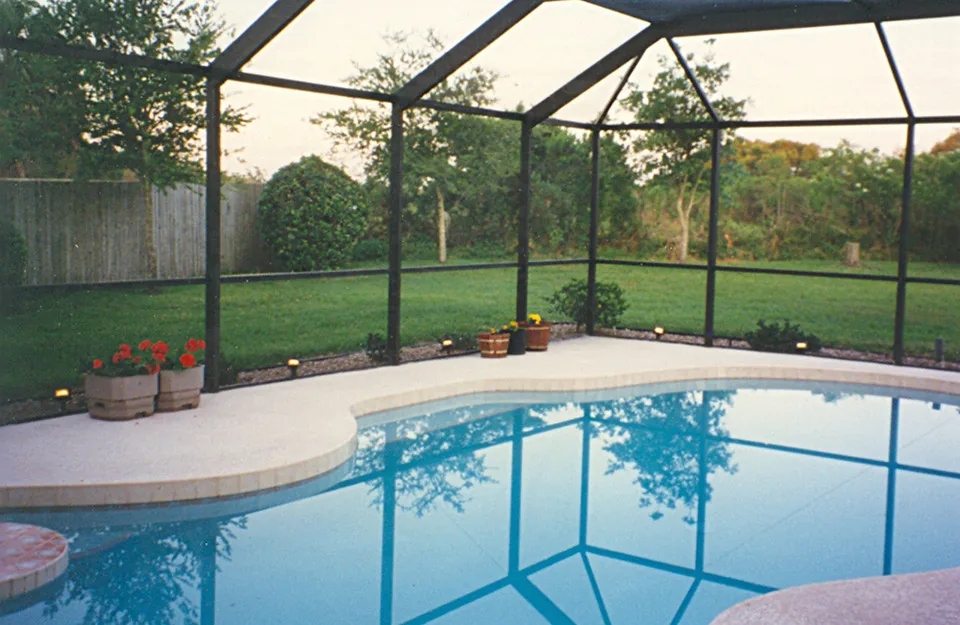
Pool Screen Enclosure FAQ for Tampa Bay, FL
Straight answers on what pool cages cost, which jobs need a permit in each county, how insurance and hurricanes affect them, and who is licensed to do the work.
These answers cover screen enclosures across Tampa Bay, FL, from Hillsborough and Pinellas to Sarasota and Hernando counties. Prices come from dated 2025 and 2026 contractor guides, and rules from each building department's own pages. For detail, see pool cage rescreening, the cost guide or the full list of services.
How much does a pool screen enclosure cost in Tampa Bay?
A new pool screen enclosure in Tampa Bay typically costs $10,000 to $30,000 or more. A mid-size cage of about 1,500 square feet built to the current Florida code averages around $23,000, which works out to roughly $12 to $25 per square foot installed (Tampa Bay contractor price guides, 2026). Gable roofs, two-story walls and coastal fasteners push the number up.
How much does it cost to rescreen a pool cage?
A full rescreen usually runs $1,500 to $4,500 or more in Florida, about $1.50 to $3.50 per square foot of screen installed. A typical 400 square foot cage in Tampa was quoted at $2,800 to $3,600 in January 2026, and large two-story cages in 20x20 No-See-Um mesh can reach $4,500 to $7,500.
How much does it cost to fix one torn pool screen panel?
Expect $75 to $150 for a single panel and $250 to $600 when several panels are done in one visit, based on Tampa Bay price guides from 2026. Many Florida screen companies also charge a minimum service call of $150 to $250, so it pays to bundle every torn panel into one trip.
Do I need a permit to build a pool screen enclosure in Tampa Bay?
Yes. Every Tampa Bay building department that publishes a rule treats a new pool cage as permitted work, and most ask for plans signed and sealed by a Florida engineer or architect. Published fees include $380 in unincorporated Hillsborough County (October 2024 schedule), $210 in Manatee County (2023), $300 in the City of Bradenton (July 2026) and $126.56 in Hernando County (2022).
Do I need a permit to rescreen a pool cage?
Not in Pasco County, Hernando County, Manatee County, the City of Bradenton or the City of Venice, which all list rescreening as work that needs no permit; Manatee still requires a licensed contractor, and Pasco's and Hernando's exemptions do not apply in flood zones. Plant City exempts non-structural screen damage. Hillsborough, Pinellas, Tampa, St. Petersburg and Sarasota publish no rescreen rule, so ask first.
How long does a pool cage last in Florida?
The aluminum frame of a well-kept pool cage lasts about 20 to 30 years or more, while standard fiberglass screen lasts about 5 to 10 years in Florida sun. That gap is why most cages get rescreened two or three times before the structure itself is replaced.
Are pool screen enclosures covered by homeowners insurance in Florida?
Often not. Citizens Property Insurance's HO-3 worksheet says screen pool cages and aluminum-framed screened enclosures open to the weather are not covered, and its hurricane flyer lists open enclosures as typically not covered. Florida's Department of Financial Services describes a separate screened enclosure endorsement for hurricane damage, so read your own policy before a storm.
Are pool cages hurricane proof?
No. A pool cage is engineered to a design wind speed, about 138 to 152 mph across Tampa Bay and 145 mph by ordinance in Pinellas County, not built to survive any storm. During Hurricane Milton in 2024, gusts of 101 to 102 mph at St. Petersburg and Sarasota-Bradenton airports were below those speeds, and a Lakewood Ranch pool cage was still reported blown apart.
Can a pool screen enclosure count as the pool barrier?
Yes, if it meets the Florida Residential Code, which says a standard screen enclosure may be used as part or all of the barrier. The barrier must be at least 4 feet high on the outside, and gates must open outward and be self-closing and self-latching (Florida Statutes 515.29). House doors that open onto the pool need a self-closing, self-latching device no lower than 54 inches (515.27).
Are pool screen enclosures worth it in Florida?
For most Tampa Bay pools, yes. Florida has more than 80 mosquito species, lovebugs swarm every April to May and August to September, and UF/IFAS specifically suggests screens over decks and swimming pools. A code-compliant cage can also serve as the barrier, one of the safety features Florida law requires on new residential pools.
How much is lanai screen repair in Tampa Bay?
Single panels run about $75 to $150, and rescreening a whole 200 to 400 square foot lanai in standard 18x14 fiberglass runs about $800 to $1,600, based on Tampa Bay price guides from early 2026. Existing lanai and patio screen projects start around $895 to $1,295 with one Tampa Bay screen company.
How do you fix a broken lanai screen?
A torn lanai panel is fixed by pulling the old rubber spline out of the frame channel, removing the damaged screen, then rolling new screen and fresh spline into the channel so the panel sits tight. If the aluminum member around the panel is bent or the screws are loose, that frame work comes first, or the new screen will pop out again.
How much does it cost to paint a pool cage?
Professional pool cage painting runs about $1.50 to $2.50 per square foot in Tampa Bay, and a full restoration that adds cleaning, fastener work and repairs runs about $6,000 to $11,000 (Tampa Bay price guide, January 2026). National guides suggest repainting an aluminum cage every 5 to 10 years.
How much does a new pool cage door cost?
A full door rebuild or replacement runs about $250 to $650 per door including hardware in Florida, while replacing just the hardware runs about $100 to $250 per door. A simple closer swap is about $50 to $150 in labor, with pneumatic closers themselves costing $15 to $40.
What does a front entry screen enclosure cost?
Most front entry screen enclosures in Florida cost about $700 to $1,800, depending on size, materials, door style and detailing, per a Sarasota-area builder. HOA approval is often needed first, and at least one Riverview HOA section does not allow front screen enclosures at all.
How much do retractable screens cost in Tampa Bay?
One Tampa Bay screen company lists manual retractable garage screens at $899 to $1,499 and motorized systems from $2,299 per opening. A Central Florida dealer puts a top-quality motorized screen at about $3,000 to $6,000 installed.
What is a super gutter on a pool cage?
A super gutter is a 5 to 7 inch wide heavy-gauge aluminum gutter that runs along the house, carries the weight of the cage roof, protects the fascia and drains the roof. In Florida, repair or replacement is quoted at about $35 to $75 per linear foot, and a quality extruded super gutter lasts about 20 to 30 years.
How much does it cost to remove a pool cage?
National figures put pool enclosure removal at about $1.00 to $2.50 per square foot, or $800 to $2,000 including cleanup and dump fees. No Tampa Bay or Florida source publishes a removal-only price, so treat that as a rough starting point.
Should I cut my pool cage screens before a hurricane?
Only if your cage was engineered for it. Florida Building Code Section 2002.7 allows an optional design in which marked screen panels are cut or removed when winds are forecast to exceed 75 mph, and those panels must be reachable without ladders or scaffolding. A standard cage is designed with its screen in place, and an engineering firm that studied the question warns against risking your safety to cut screens when you should be sheltering.
How does a hurricane deductible affect a pool cage claim?
Florida insurers must offer hurricane deductibles of $500 or 2, 5 or 10 percent of the dwelling limit (Florida Statutes 627.701), applied once per calendar year. On a $400,000 dwelling limit, a 2 percent deductible is $8,000, so a $4,500 pool cage repair on its own would sit entirely under the deductible, even on a policy that covers enclosures.
What license does a screen enclosure contractor need in Florida?
The state category built for this work is the Specialty Structure Contractor license, which covers screened porches, screened enclosures and pool enclosures but not work that alters the house's structure (Florida rule 61G4-15.015). Hillsborough County also issues a local Aluminum Structure license, and Pinellas County contractors must be registered with the Pinellas County Construction Licensing Board.
What is HB 803 and does it cover pool cage work?
HB 803 created Florida Statutes 553.79(1)(g), which since July 1, 2026 lets single-family owners skip a permit for work valued under $7,500 by filing a written request. It excludes structural work and any property partly or fully in a flood hazard area, so a new cage never qualifies, and whether a rescreen does is up to each building official.
Which screen keeps out no-see-ums?
Phifer's 20x20 No-See-Um fiberglass, a tighter weave than standard 18x14, is made to keep out no-see-ums, gnats and sand flies common near marsh and coast. In Florida it usually adds about $10 to $20 per panel over standard mesh, and many owners use it only on walls facing water.
Do HOAs in Tampa Bay restrict pool cage colors?
Often, yes. FishHawk Ranch allows bronze, white or black frames with charcoal screen; Seven Oaks in Wesley Chapel requires white or bronze frames with charcoal screen; Meadow Pointe allows white or brown frames with smoke or gray screen. Check your community's architectural guidelines before choosing a frame color or privacy screen.
When is lovebug season in Tampa Bay?
Lovebugs swarm in Florida for a few weeks every April to May and again in August to September, according to UF/IFAS. The same UF/IFAS publication suggests screens over decks and swimming pools, so a torn panel is worth fixing before either season starts.
Last reviewed October 2026.
Have a question about your own cage?
Describe the job and the town in the form. Get a free quote. No obligation.
Get a Free Quote