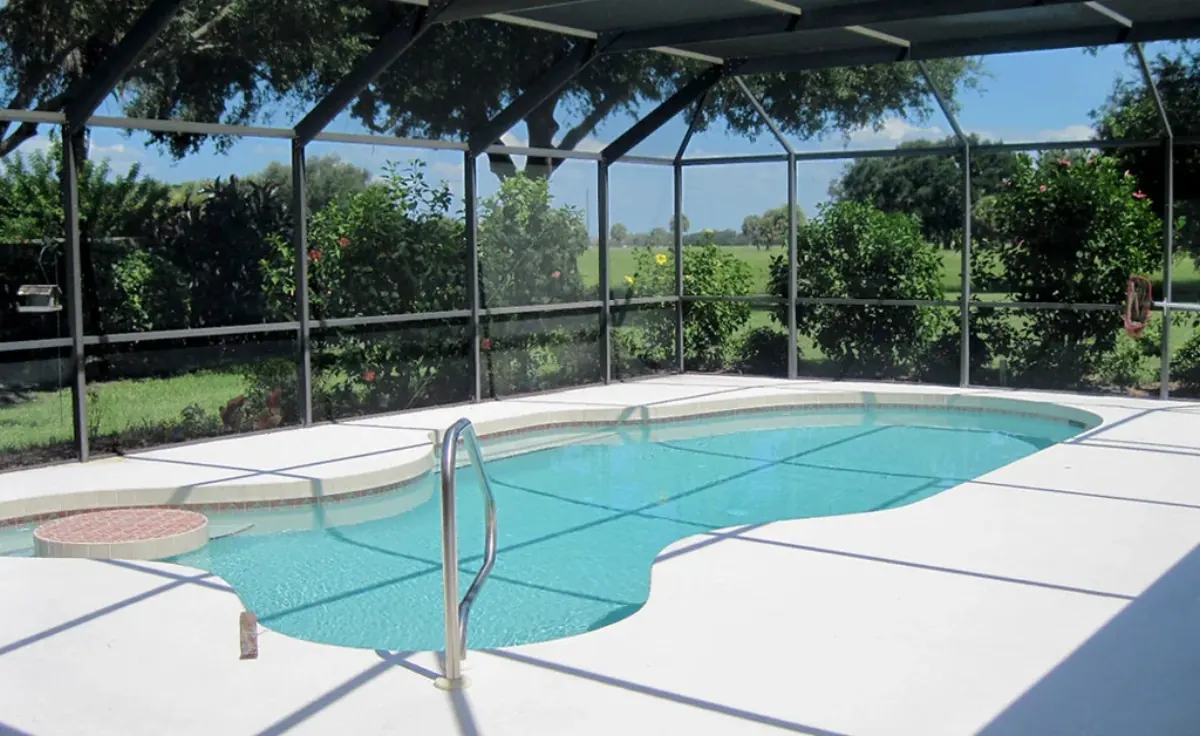
Pool cage rescreening in Tampa Bay usually costs about $1,500 to $4,500 for a full cage, and it is the job most Florida pool owners face every 5 to 10 years. The aluminum frame of a pool enclosure outlasts the screen by decades, so when the mesh fades, tears or sags, the usual answer is new screen in the old frame, not a new cage. This page covers pool cage rescreening Tampa homeowners ask about: price, screen choices, lifespan, permits and how to tell whether the frame still has years left.
It applies across Hillsborough, Pinellas, Pasco, Manatee, Sarasota and Hernando counties, from Wesley Chapel and Brandon to St. Petersburg, Bradenton and Venice. Sun, salt air, summer storms and lovebug season all wear screen down here faster than in most of the country.
What pool cage rescreening costs in Tampa Bay
A typical one-story cage costs roughly $1,500 to $3,500 to rescreen in standard fiberglass, and the price rises with three things: how much screen there is, how high it goes, and which mesh you choose. Published local and Florida figures agree on the shape of it, even where their exact numbers differ.
| Job | Published range | Where the figure comes from |
|---|---|---|
| Full rescreen, Florida average per sq ft | $1.50 to $3.50 per sq ft installed | Florida contractor guides, Dec 2025 and Mar 2026 |
| Full rescreen, typical Florida total | $1,500 to $4,500+ | Florida contractor guides, Dec 2025 and Mar 2026 |
| 400 sq ft cage in Tampa, full rescreen | $2,800 to $3,600 | Tampa Bay contractor guide, Jan 2026 |
| 200 to 400 sq ft lanai, 18x14 fiberglass | $800 to $1,600 | Tampa Bay contractor guide, Mar 2026 |
| 20x40 cage in polyester screen | $2,500 to $4,500 | Tampa Bay contractor guide, Mar 2026 |
| Large two-story cage in 20x20 No-See-Um | $4,500 to $7,500+ | Tampa Bay contractor guide, Mar 2026 |
| Mid-size cage, 20 to 40 panels | $1,500 to $3,200 | Central Florida screen company, 2026 |
| Large or two-story mansard, 40 to 60+ panels | $2,800 to $4,500 | Central Florida screen company, 2026 |
Swipe the table sideways to see every column →
Compiled from published contractor price guides fetched 2026-10-13 (a Florida contractor price guide from December 2025, a Tampa Bay screen contractor's 2026 cost guides and a Central Florida screen company's 2026 guide). National sites quote wider and sometimes conflicting per-square-foot figures, so treat these as a planning range, not a quote.
What moves the price
- Screen area: a 20x40 cage with a tall mansard roof can hold 800 to 1,200 sq ft of screen.
- Height: second-story panels and high roof panels need more ladder and scaffold time.
- Mesh: polyester adds roughly 20 to 30 percent over standard fiberglass, and No-See-Um adds about $10 to $20 per panel.
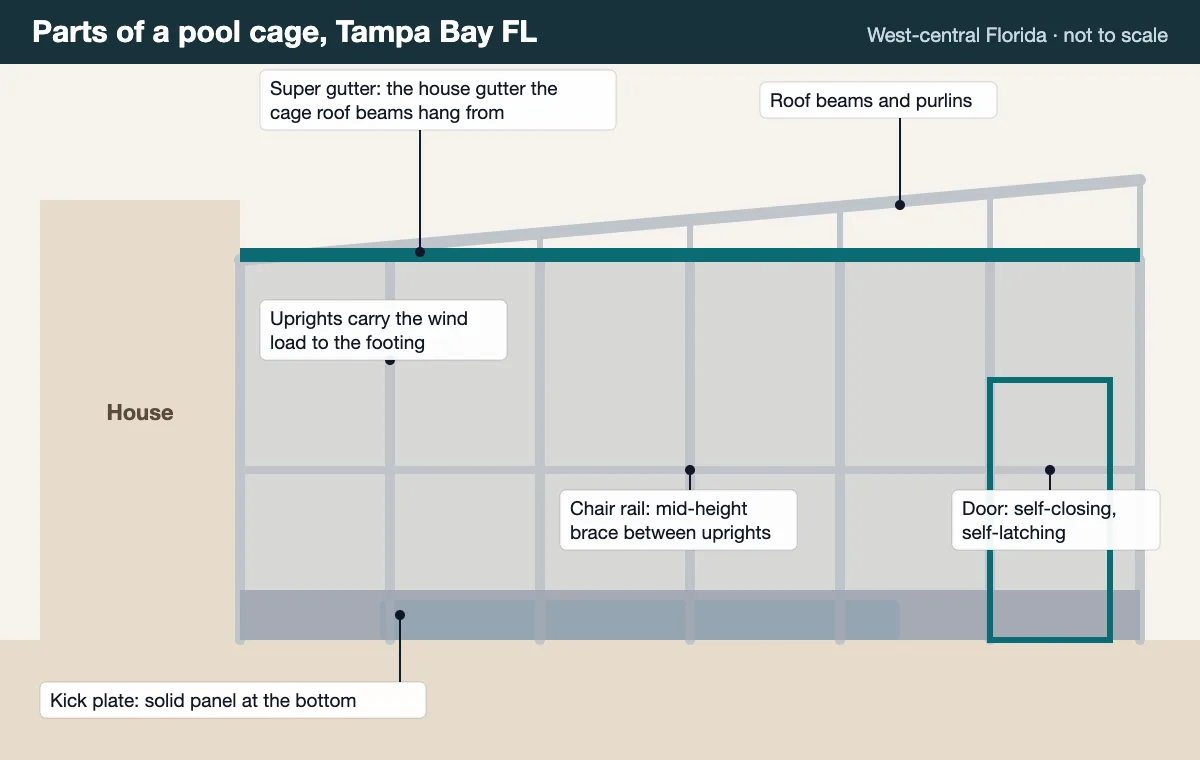
- Frame work: loose screws, missing kick plates or a bent member add metal work on top of the screen.
- Doors: every door screen, closer and latch is extra if it needs work.
- Access: tight side yards, landscaping and furniture on the deck all add time.
Which screen to choose
Most Tampa Bay cages are rescreened in standard 18x14 fiberglass, and that is the right call for most yards. The upgrades exist for specific problems: tiny biting insects, pets, privacy or a cage that takes a beating. You can also mix them, for example No-See-Um on the walls facing the water and standard mesh on the roof.
| Screen | What it is | Best for |
|---|---|---|
| 18x14 fiberglass | Phifer's traditional pool and patio mesh | Most cages; lowest cost |
| 20x20 No-See-Um | Tighter fiberglass weave for gnats and sand flies | Homes near marsh, mangroves, canals or the bay |
| PetScreen | Tear and puncture resistant mesh | Lower panels and doors where dogs and cats push |
| TuffScreen | Heavy-duty vinyl-coated polyester | High-traffic panels; longer life |
| Glas-Shield | Vinyl-laminated 18x14 fiberglass | Below the chair rail and privacy walls; not for roofs |
Swipe the table sideways to see every column →
Product descriptions from Phifer's own product pages (phifer.com), fetched 2026-10-13.

The pool cage screen types guide goes through each mesh in more detail, including how visible each one is from inside the cage.
How long a rescreen lasts in Florida
Standard fiberglass pool screen usually lasts 5 to 10 years in Florida, and premium mesh 8 to 15. Contractors writing for Florida put fiberglass at 5 to 7 years in harsh sun and up to 7 to 10 in a typical Tampa Bay yard. National guides quote longer lifespans, but they are not written for a place with Tampa's sun, humidity and storms.
The frame is a different story. Florida contractors put a well-kept aluminum pool enclosure at 20 to 30 years or more, so most cages are rescreened two or three times before the frame itself needs replacing.
Signs it is time to rescreen
- Screen that has gone chalky, brittle or tears when you press it with a finger
- Panels sagging or popping out of the channel after a storm
- Holes from palm fronds, branches or pets in more than a handful of panels
- Mildew or dark staining that does not wash out
- Bugs getting in even with the doors shut
- A roof panel letting oak leaves and pine needles fall into the pool
A few torn panels are a pool screen repair job, priced per panel. Once a quarter or more of the cage is failing, a full rescreen usually costs less per panel and leaves every panel the same age and color.
How a pool cage is rescreened
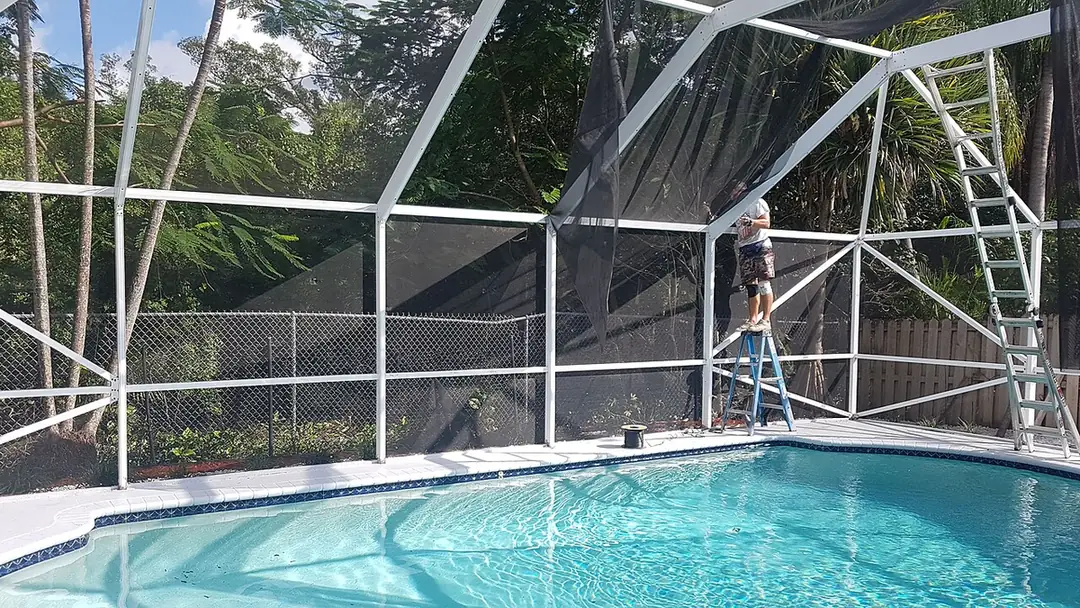
A full rescreen replaces the mesh and the spline in every panel while the aluminum frame stays put. A typical job runs in this order:
- 1Check the frame first
Look for bent beams, cracked welds, loose or rusted screws and gaps where the frame meets the house or deck. Frame problems are fixed before any screen goes in.
- 2Strip the old screen and spline
The old mesh and the rubber spline that holds it are pulled out of every channel, and the channels are cleaned so the new spline seats evenly.
- 3Roll in the new screen
New mesh is stretched over each panel and pressed into the channel with fresh spline, working panel by panel so the screen stays tight and square.
- 4Trim, then deal with doors and kick plates
Excess mesh is trimmed, door screens are redone and the door closer and latch are checked so the door still closes and latches on its own.
- 5Clean up
Old screen, spline and offcuts are bagged and hauled away, and the deck and pool are cleared of debris.
Do you need a permit to rescreen?
Screen-only rescreening is on the no-permit list in several Tampa Bay jurisdictions, but not all of them say so. Anything that touches the structure, like new beams, a rebuilt door frame or storm repairs, is a different matter.
| Jurisdiction | Rescreen-only work | Source |
|---|---|---|
| Pasco County | Listed as not needing a permit (not in flood zones) | Pasco County permit exemptions list |
| Hernando County | Listed as not needing a permit | Hernando County residential exemption list, Aug 2026 |
| Manatee County | No permit, but a licensed contractor is required | Manatee County, work not requiring a permit, Jun 2026 |
| City of Bradenton | Listed as not needing a permit | City of Bradenton, work not requiring a permit |
| City of Venice | Listed as not needing a permit | City of Venice permit exemptions |
| Plant City | Non-structural screen damage needs no permit | Plant City disaster permitting page |
| Hillsborough, Pinellas, Tampa, St. Pete, Sarasota | Not stated; ask before the job | Their building department pages do not list it |
Swipe the table sideways to see every column →
From each building department's published exemption list, fetched 2026-10-13. Rules change; confirm with your building department for your address.
Screen enclosure work in Florida is done under a state license category built for it: the Specialty Structure Contractor license covers screened porches, screened enclosures and pool enclosures. Hillsborough County also issues a local aluminum structure license. Asking for the license number before you sign is reasonable on any job.
The Tampa Bay pool enclosure permit guide covers new enclosures, fees and engineering county by county.
Rescreen, repair or replace?
Rescreen if the frame is straight and sound; replace if it isn't. Florida Building Code Section 2002 sets the rules for aluminum pool enclosures, including a minimum wall thickness for the framing and wind design by location, and new screen does nothing for a frame that no longer meets them.
- Rescreen: frame straight, fasteners tight, only the mesh is worn
- Repair first, then rescreen: a few loose or rusted screws, a missing kick plate, a door that drags
- Replace: bent or kinked beams, corrosion through the metal, a cage that racks when you push it, storm damage to the structure
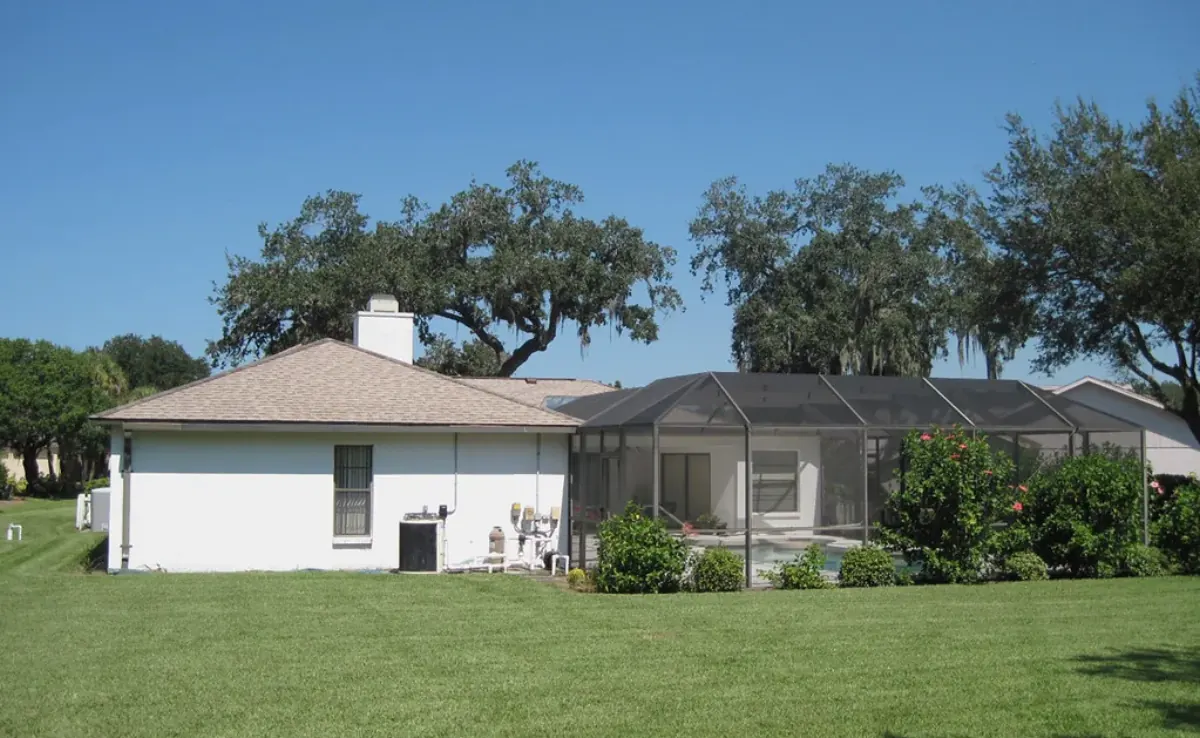
Frames near the coast deserve a closer look. University of Florida research on screen enclosure fasteners found corrosion more serious in coastal environments because of chloride from salt air, which matters in St. Petersburg, Clearwater, Apollo Beach and along the Gulf beaches. If the frame is past saving, see pool cage replacement. If it only looks tired, a rescreen pairs well with pool cage painting so the screen and frame finish looking new together.
HOA rules on screen color
Many Tampa Bay HOAs control frame color and screen color, so check before you choose a mesh. Charcoal screen is the common requirement. A few published examples:
- FishHawk Ranch: bronze, white or black frames with charcoal screen only.
- Seven Oaks in Wesley Chapel: white or bronze frames with charcoal screen.
- Meadow Pointe in Wesley Chapel: white or brown frames with smoke or gray screen.
- Lakewood Ranch: charcoal screen; a like-for-like replacement needs no approval in its guidelines.
Like-for-like rescreening is usually the easy case. Changing screen color or adding a privacy screen is where an architectural review application is most often needed.
Pool cage rescreening across Tampa Bay
Pool cage rescreening comes up across the region, from Brandon, Riverview and Wesley Chapel to St. Petersburg, Bradenton and Sarasota. Every town is on the service area page. For prices in more depth, read the pool cage rescreening cost guide, or request a free quote.