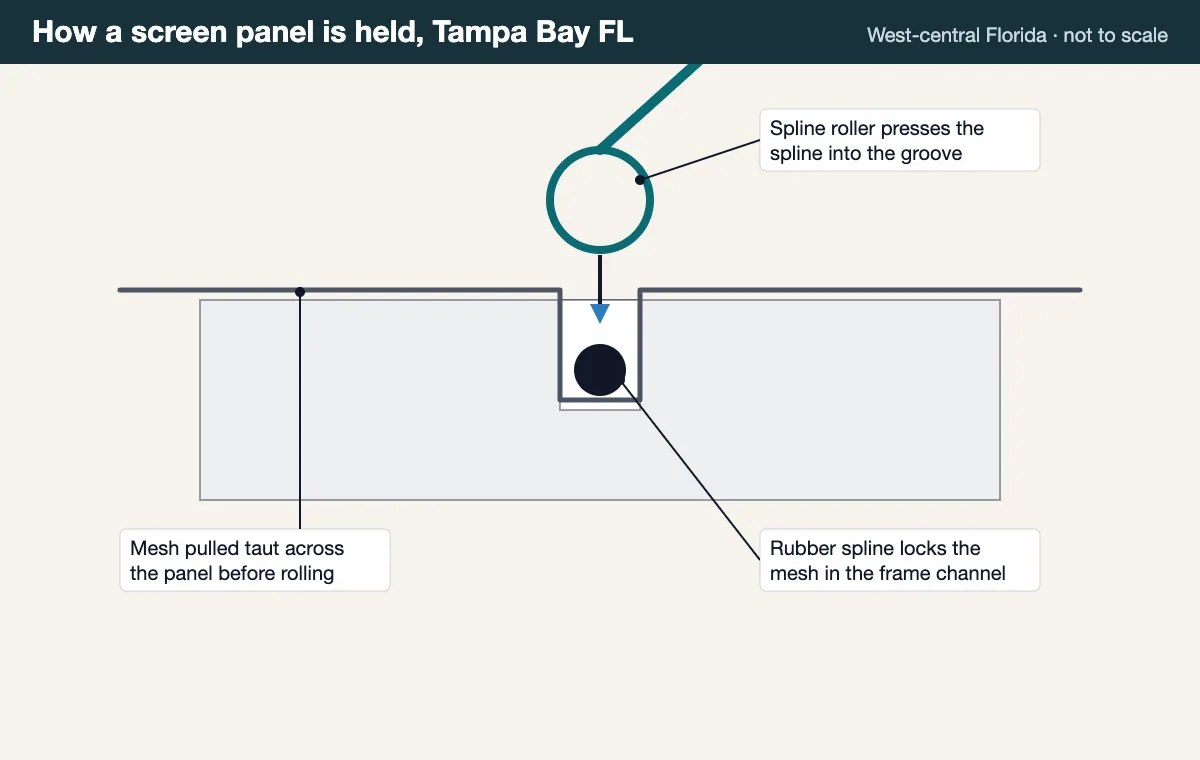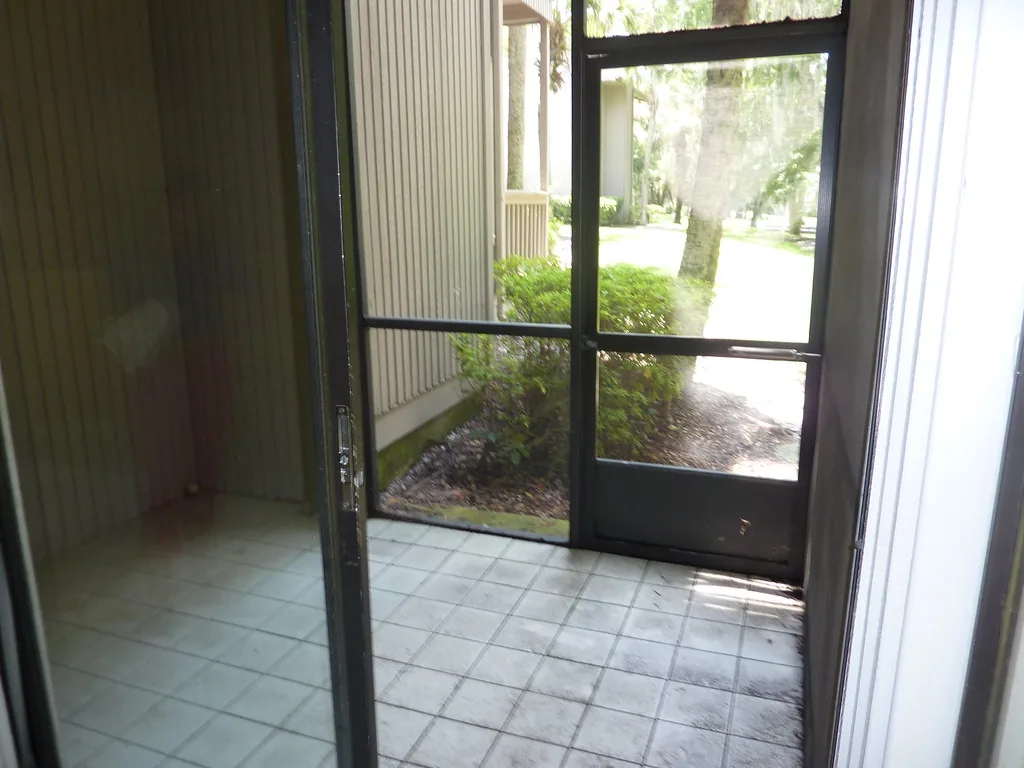
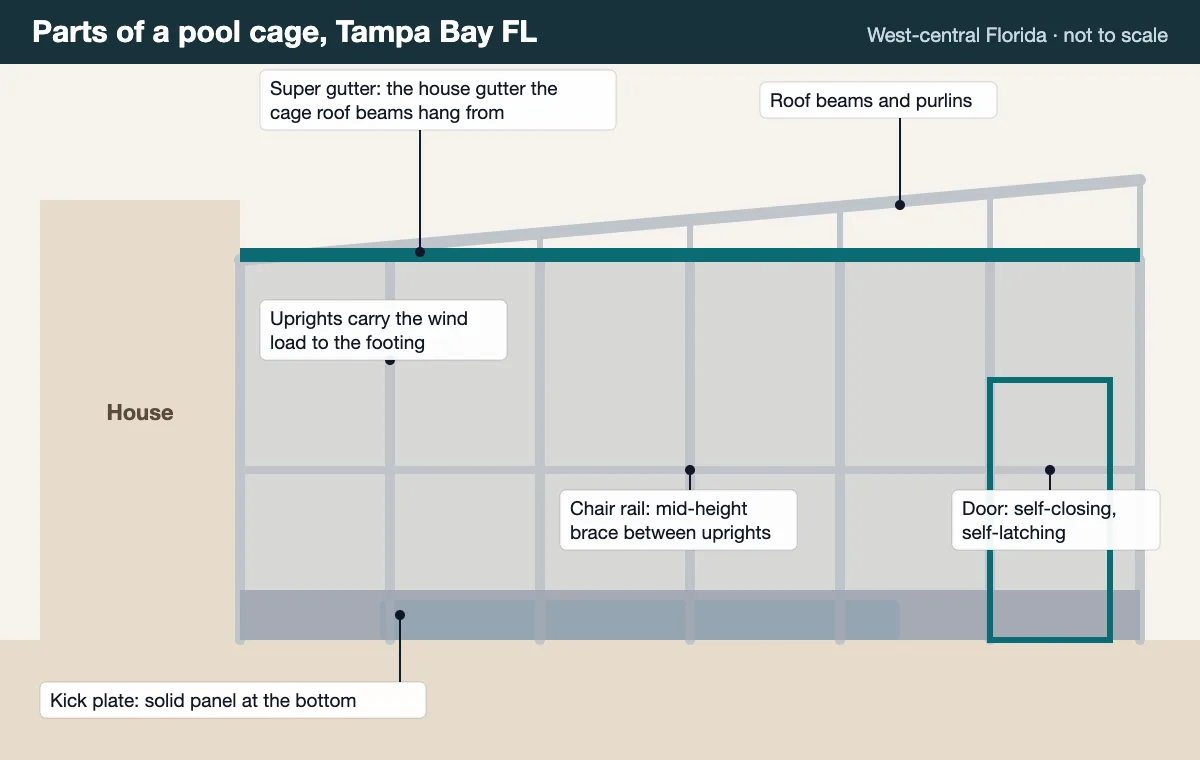
Pool cage door replacement in Tampa, FL is published at $250 to $650 per door with hardware, and many door problems cost far less than that because only the closer or latch has failed. The door is the one part of a pool cage that moves many times a day, so it wears out long before the frame around it.
It is also the part Florida law cares most about. When a cage serves as the pool's safety barrier, its door has to open outward, close by itself and latch by itself. This page covers pool cage door replacement Tampa homeowners ask about: costs, the rules, closers, latches, sweeps and kick plates, across Hillsborough, Pinellas, Pasco, Manatee, Sarasota and Hernando counties.
Why the door goes first
A door takes impact every time it slams, and a cage frame does not. The closer pulls it shut, the latch takes the hit, the hinges carry its weight on one side, and kids, dogs and pool toys push on its lower panel. When the cage frame shifts even slightly in a storm, the door is where it shows first: it starts to drag, stops latching, or leaves a gap at the top.
Signs a door needs work
- The door stays open or stops a few inches short instead of closing on its own
- It closes but does not latch unless you push it
- It slams hard enough to rattle the frame
- It drags on the deck or leaves a gap at the bottom that lizards and frogs come through
- The gap between door and frame is wider at the top than the bottom
- The latch is loose, stiff or rusted, or the handle spins
- The screen in the door is torn or the kick plate is dented or missing
- Hinges are cracked, rusted or pulling their screws out of the frame
Repair the door or replace it?
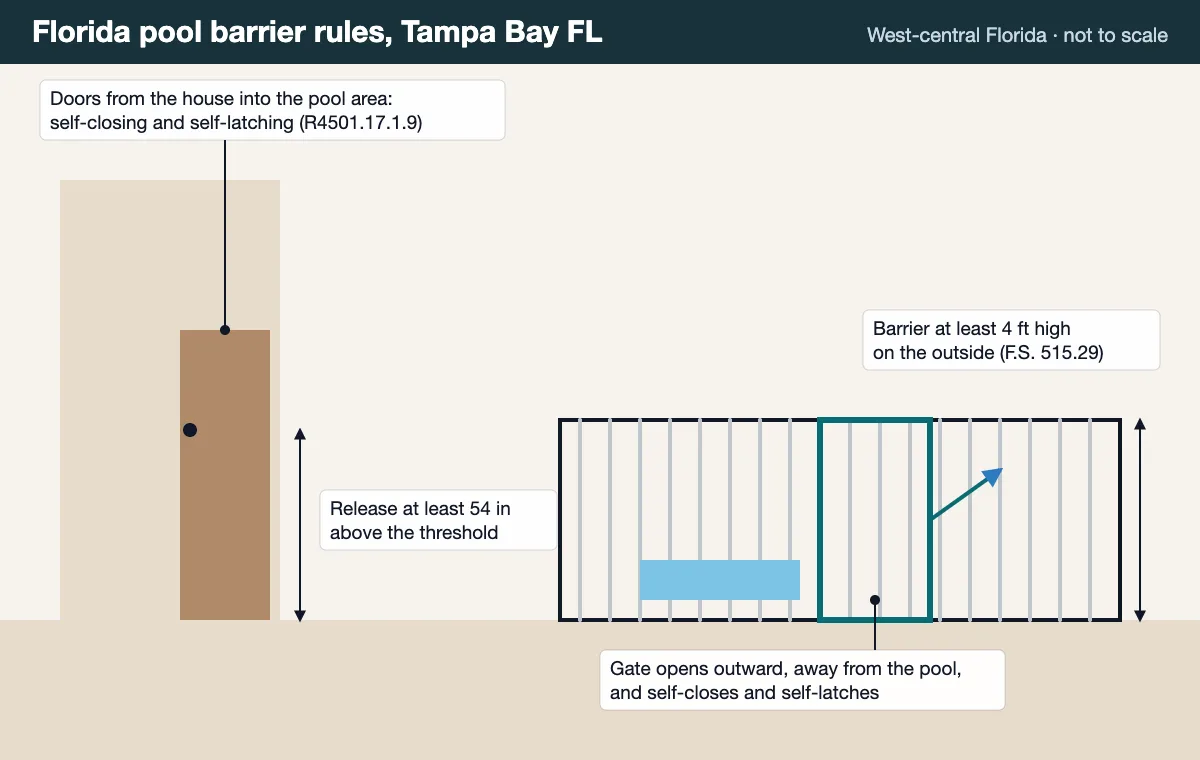
Repair it if the door is still square; replace or rebuild it if it is not. A straight door with a failed closer or latch is a parts job. A door that has twisted, cracked at its corners, or no longer fits its opening will keep failing no matter how many closers go on it.
| Problem | Usual fix | Repair or replace? |
|---|---|---|
| Door will not close on its own | Adjust or replace the closer | Repair |
| Door closes but will not latch | Realign or replace latch and strike | Repair |
| Door slams | Adjust closer speed or replace a worn closer | Repair |
| Gap at the bottom | New sweep or bottom weatherstrip | Repair |
| Torn door screen or dented kick plate | Rescreen the door panel, new kick plate | Repair |
| Sags on the hinge side | New hinges, refastened to the frame | Repair, if the door is straight |
| Door twisted or corners cracked | Rebuild or replace the door | Replace |
| Opening out of square after a storm | Frame repair, then a door fitted to it | Replace, plus frame work |
Swipe the table sideways to see every column →
Compiled from Tampa Bay and Florida screen contractor service and price pages, fetched 2026-10-13.
What pool cage door work costs
Most single-door jobs land between $100 and $650. Hardware is the low end, a full door rebuild the high end, and the published figures below show where each part falls.
| Job | Published price | Where the figure comes from |
|---|---|---|
| Door rebuild or full replacement | $250 to $650 per door, with hardware | Florida screen company, 2026 |
| Door hardware replacement | $100 to $250 per door | Tampa Bay contractor guide, Mar 2026 |
| Closer swap on an existing door | $50 to $150 labor | Tampa Bay contractor guide, Jul 2026 |
| Pneumatic closer, part only | $15 to $40 | Tampa Bay contractor guide, Jul 2026 |
| Door panel with kick plate | $90 to $180 | Florida screen company, 2026 |
| Hardware plus weatherstripping | $30 to $115 | HomeGuide, national, 2023 |
| Self-closing hinges | $7 to $30 | HomeGuide, national, 2023 |
| Childproof safety locks | $10 to $50 | HomeGuide, national, 2023 |
| Service call minimum | $150 to $250 | Florida screen company, 2026 |
Swipe the table sideways to see every column →
Compiled from published price pages fetched 2026-10-13. Most Florida screen companies charge a minimum per visit, so a single closer swap can cost more than its parts and labor suggest. A planning range, not a quote.
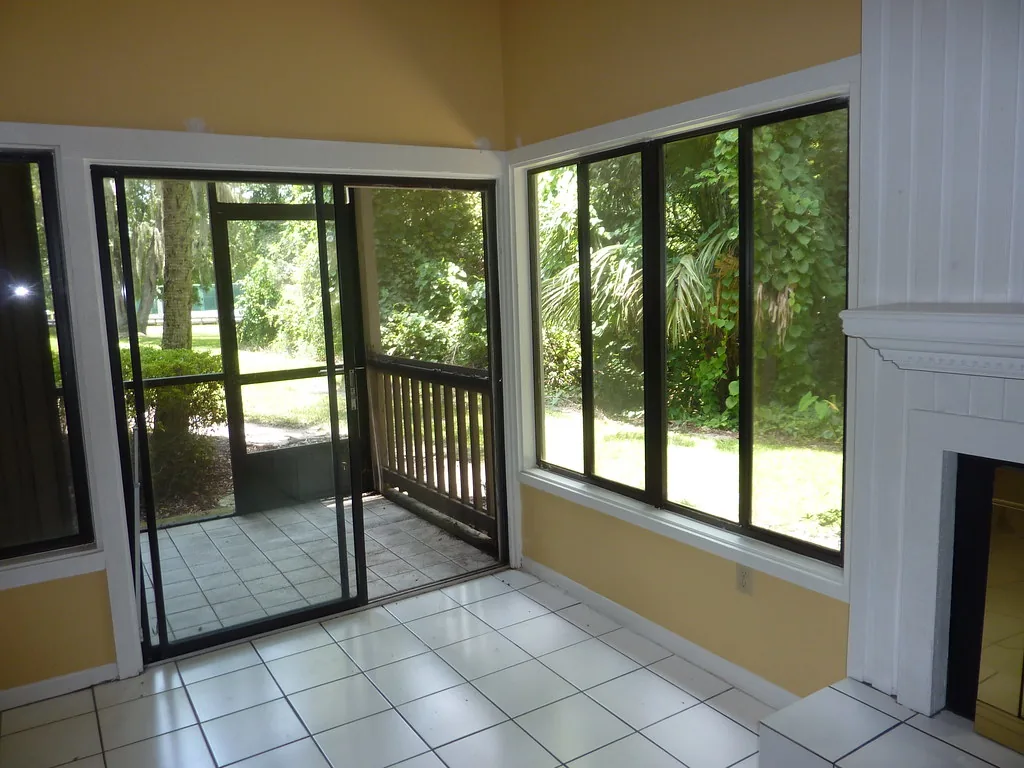
Florida rules for pool cage doors
If your cage is the pool's barrier, its door has to open outward, self-close and self-latch. That comes from Florida's Residential Swimming Pool Safety Act, Chapter 515 of the Florida Statutes, and the pool chapter of the Florida Residential Code, which says a standard screen enclosure can serve as part or all of the barrier. The rules side by side:
| Rule | What it requires | Applies to |
|---|---|---|
| F.S. 515.29(3) | Open outward, away from the pool; self-closing; self-latching; release on the pool side, out of a young child's reach over the top or through a gap | Gates and doors in the pool barrier, including a cage used as the barrier |
| F.S. 515.29 | Barrier at least 4 feet high on the outside, with no gaps or footholds a young child could crawl under, squeeze through or climb | The whole barrier |
| Florida Residential Code R4501.17.1.8 | Self-latching device on the pool side; if the release is at least 54 inches from the bottom of the gate, it may be on either side | Barrier gates |
| F.S. 515.27(1)(d) | Self-closing, self-latching device with the release no lower than 54 inches above the floor | House doors that open directly to the pool |
| F.S. 515.27 | Exit alarm of at least 85 dB A at 10 feet | House doors and windows that open directly to the pool |
| City of New Port Richey | Every screen enclosure door swings out, self-closes and self-latches; latch at least 54 inches above the exterior landing | Screen enclosure doors inside city limits |
| Hernando County exemption | An exempt screen enclosure under an existing roof needs at least one 36 inch door, with the screen door matching that width | Enclosures built under the county's exemption |
Swipe the table sideways to see every column →
From Florida Statutes 515.25, 515.27 and 515.29, Florida Residential Code 2023 Chapter 45, New Port Richey's 2026 residential pool safety worksheet and Hernando County's residential permit exemption list, fetched 2026-10-13. A young child under the statute is anyone under 6.
Closers: the part that fails most
A pneumatic closer is a $15 to $40 part, and replacing one is usually the cheapest fix for a door that will not shut. A Tampa Bay contractor's July 2026 guide puts a straightforward closer swap at $50 to $150 in labor. Some doors use self-closing spring hinges instead, priced at $7 to $30 in national figures.
- A closer that leaks, sticks or lets the door bounce open has usually reached the end of its life
- A closer can often be adjusted for speed before it needs replacing
- The closer has to shut the door fully from wide open, not just from halfway
- A hold-open washer left engaged defeats the self-closing rule; remove or disable it on a pool door
- Near the bay and Gulf, check the closer brackets and screws as well as the cylinder: University of Florida research found salt air makes enclosure fastener corrosion more serious
Latches, handles and locks
The latch has to catch on its own every time the door closes, and its release has to be out of a small child's reach. Most latch problems are alignment: the cage frame moves a little, the latch no longer meets its strike, and the door bounces off instead of catching. Realigning the strike fixes many of them. A worn or rusted latch is part of the $100 to $250 hardware range, and childproof locks add $10 to $50.
If your latch release is low on the outside of the door, the replacement is a chance to bring it in line with the code: on the pool side, or high enough to be out of reach. In New Port Richey, that means at least 54 inches above the landing outside the door.
Sweeps, kick plates and the bottom of the door
A sweep closes the gap between the door and the deck; a kick plate protects the lower panel. Both take the most abuse on the door. A missing sweep lets in frogs, lizards and leaves, and it can leave a gap at the bottom of a barrier, which Florida Statute 515.29 does not allow if a young child could squeeze through. A national guide prices hardware plus weatherstripping at $30 to $115, and a Florida company prices a door panel with kick plate at $90 to $180. Some HOAs, including Meadow Pointe in Wesley Chapel, recommend kick plates along the entire lower edge of the enclosure.
Which screen to put in the door
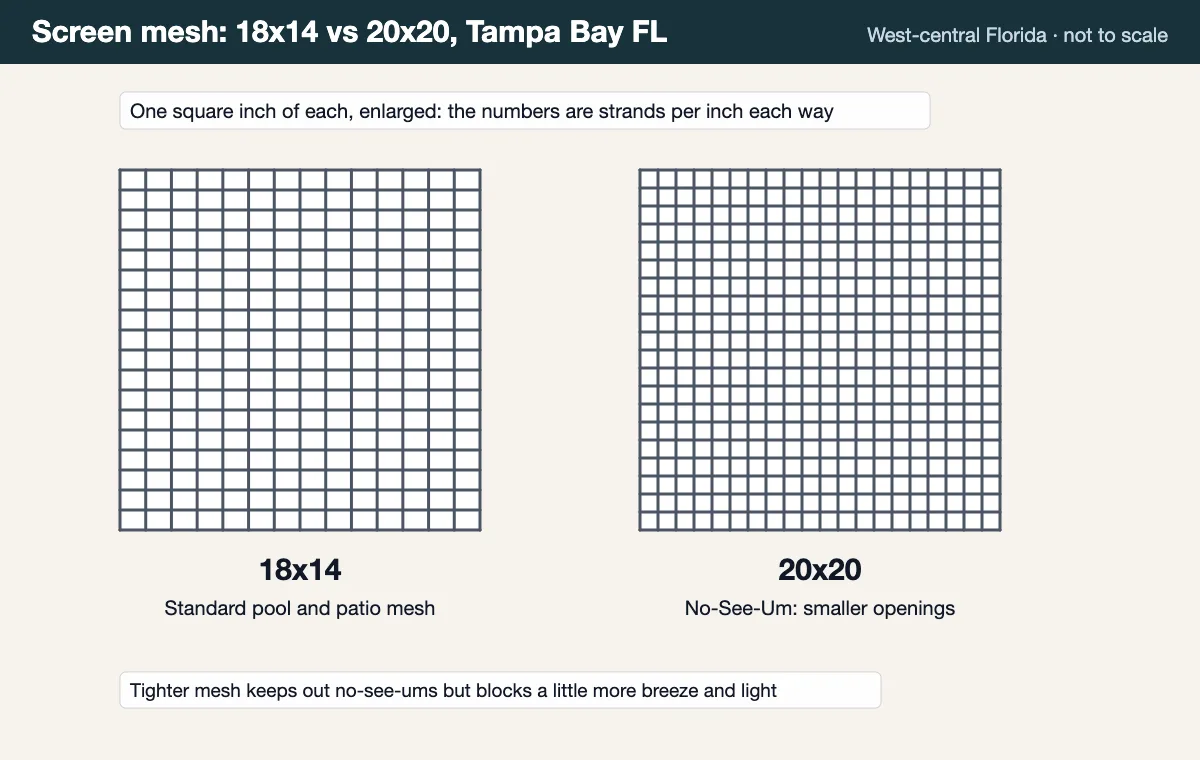
The door panel is the screen most likely to meet a paw, a knee or a pool noodle, so it is worth choosing on its own. Phifer describes its PetScreen as tear and puncture resistant against most dogs and cats, made for patio and porch enclosures as well as windows and doors. Its vinyl-laminated Glas-Shield is made for lower panels, below the chair rail, where it keeps dirt and debris out. Phifer makes its 20x20 No-See-Um mesh for marshy and coastal areas, so a cage screened in it needs the same mesh in the door. If your HOA sets a screen color, such as charcoal in FishHawk Ranch and Westchase, the door screen follows the same rule.
In Hernando County, repairing or replacing screen is on the list of work that can be done without a contractor license, as long as no aluminum is installed. Rehanging a door or replacing its frame is aluminum work, so that exemption stops at the screen.
Permits and licensing for door work
Hardware swaps rarely need a permit, but a new door in a pool barrier can. Manatee County lists repairs of hardware or fasteners among work that needs no permit, but requires a licensed contractor to do it. North Port's policy on Florida's new under-$7,500 exemption (HB 803) lists pool barriers, fences, windows and doors as structural items that still need a permit. Rules elsewhere are not published, so check with your building department before a door is moved or its opening changed.
Screen enclosure work in Florida falls under the Specialty Structure Contractor license, and Hillsborough County also issues a local aluminum structure license. The Florida pool enclosure requirements guide covers the barrier rules in more detail.
How a pool cage door replacement goes
Diagnose, measure, hang, fit hardware, test. A typical door job runs in this order:
- 1Find what failed
Closer, latch, hinges, sweep, the screen in the door, or the door frame itself. A door that is square only needs parts.
- 2Measure the opening
The opening is measured at the top, middle and bottom, because a shifted cage frame often leaves it out of square.
- 3Hang the door
A rebuilt or new door is hung on its hinges so it swings outward, away from the pool, with even gaps on all sides.
- 4Fit closer, latch and sweep
The closer is mounted and adjusted so the door shuts fully from any open position, the latch catches its strike every time, and the sweep closes the gap at the deck.
- 5Test it
The door is opened wide and released several times to confirm it closes and latches by itself, and the latch release is checked for height and side.
A two-minute monthly door check
Open the door all the way, let go, and walk away: it should close and latch with no help. Then run the rest of this list:
- Release the door from halfway open: it still closes and latches
- Push on the closed door: the latch holds
- The door swings outward, away from the pool
- The latch release is on the pool side or out of a small child's reach
- No gap at the bottom a small child or pet could fit through
- Hinges tight, no screws backing out of the frame
- No hold-open washer engaged on the closer
Doors as part of a rescreen or bigger job
If you are already rescreening, have the door done at the same visit. Door screens, closers and latches are a normal line on a pool cage rescreening estimate, and doing them together avoids a second service call minimum. A few torn wall panels next to the door are a pool screen repair. If the door stopped fitting after a storm, the frame may need work first: see hurricane damage repair. Screened entries at the front of the house have their own page, front entry screen enclosures.
Pool cage door replacement across Tampa Bay
Door repairs come up across the region, including New Port Richey, where the city sets its own door rule, Brandon, Clearwater, Spring Hill and Bradenton. Every town is on the service area page, or request a free quote.